How to Make an RF or Microwave Power Splitting Network
By Doug Jorgesen, Posted Mon Oct 07 2024 23:01:00 GMT+0000 (Coordinated Universal Time)
A common issue in microwave and RF systems is creating a power splitting network. This might be done for clock distribution, for a phased array radar, for a multiple input-multiple output system, or for other signal processing purposes. This note is a case study, a design example for an 8 way, 6-20 GHz 8-way power splitting network. We will study different methods for creating an 8 way surface mount split using Wilkinson and resistive power dividers in different configurations, as well as amplifiers, attenuators, and equalizers. We will consider 10 different configurations in total, and show the effect of layout and component selection on critical system parameters.
Summary
The data from these simulations suggests the following broad conclusions:
- Cascading low loss Wilkinson power dividers, especially with long equal distances, can lead to large standing waves, which can be mitigated in various ways
- Making the line lengths uneven can reduce the standing waves at the expense of phase balance
- Using an integrated four way power divider (such as the MPD4-0422CSP2) can mitigate the standing waves at the expense of layout flexibility
- A cascade of resistive power dividers will have better insertion loss flatness and especially return loss, at the expense of significantly increased loss
- A combination of resistive power dividers with integrated four way Wilkinson power dividers provided excellent performance across all specifications
- The addition of amplifiers can improve match and distant isolation while adding gain and improving noise figure
- While attenuators and equalizers can be used to improve the matching, especially at the input and output, the tradeoff in loss may not be as beneficial as using a resistive power divider for some stages.
- Amplitude balance is dominated by the underlying balance of the power divider and will degrade with each successive stage.
In a previous note, we discussed different ways to make an N-way power splitter. In that article we showed how using a series of 2 or 4 way connectorized module power dividers provided superior performance to what could be realized with a microstrip power divider. What if you need a multiway power split in a system, as in a phased array antenna for example? Our previous article only touched on making branched surface mount power splitting networks. In this note we’ll look more carefully at what happens when you cascade multiple power splitters and how their specs affect the ultimate output. In doing so we’ll show how the optimal way to make a small, high performance power splitting network is by using Marki’s new line of chip scale package power dividers.
Important Power Splitter Specifications
Here are the different specs of the individual and combined power dividers that we need to watch out for.
- Insertion Loss: While loss might seem like the most important spec, in many cases it doesn’t affect the signal integrity that much. Still in a large cascade it can add up quickly.
- Return Loss: This quantifies the reflected energy from the device. In a cascade of power dividers this is very important, since a stack of reflections can seriously degrade the signal or clock integrity.
- Isolation: Isolation is the loss between two different outputs of the power splitting network. Higher is better, and typically the loss between adjacent outputs is the worst case (i.e. lowest). Isolation between far away channels usually takes care of itself.
- Amplitude and phase balance: This specifies how close to identical the signals are in power level and time/phase. Lower is better if you need this, but some applications don’t (if the system is calibrated, for example). For timing/clock applications phase balance is typically more important than amplitude.
These are specified for the individual power dividers, as well as the important specifications for the completed power splitter network.
Types of Power Splitters
In this note we’ll consider two types of power dividers: Wilkinson power dividers and resistive power dividers. Wilkinson power dividers are much more common in RF and Microwave applications because they offer low loss and high isolation. Resistive power dividers are used less frequently because they have higher loss and no isolation, but they have better low frequency return loss. We won’t be considering our high isolation bridge power combiners since those are typically used for power combining applications. For a high isolation power combining network we would recommend using the high isolation bridge combiners as the first, input stage to the combining network and then Wilkinson power dividers after that to reduce the loss.
Cascade of Two Way Wilkinson Power Dividers
The most obvious way to make a power splitting network is by cascading multiple stages of two way power dividers. This creates a network with 2n outputs. Designing three way, five, or seven way power dividers is with equal output power is very difficult. Therefore, if a number of outputs other than 4,8,16, 32, or 64 is required it is still often better to create a network with too many outputs and simply terminate the unneeded outputs with 50 ohm loads.
Next is the question of which power divider to use, and how to lay them out. First consider a cascade of Wilkinson power dividers. These simulations use the MPD-0422FCSP2, simulated as S-parameters with microstrip sections in between on a schematic level circuit solver. This is a 4-22 GHz Wilkinson power divider in a tiny 2.5mm CSP package with the outputs on the front. In each category we will compare the standalone 2 way specification to the 8 way splitter built with a cascade of 7 individual power dividers in four scenarios plus the baseline:
1) MPD-0422FCSP2 alone
2) No separation between power dividers (one output feeds immediately into the next input)
3) A short separation of 0.1” (2.54mm) to allow for layout
4) A longer separation of 0.5” (12.7mm) representing a far separation in the tree
5) Random separations ranging from 0.02” (0.5mm) to 0.115” (2.9mm)
Insertion Loss:

As you can see, the MPD-0422FCSP2 has very flat insertion loss across the operating band. This flatness is mostly maintained when cascaded with no line length between, but as even short amounts of line length between dividers is added there develop significant ripples in the insertion loss, which become worse as the length is increased. When the lines are randomized, however, the ripples disappear. The reason will become clear when we look at return loss.
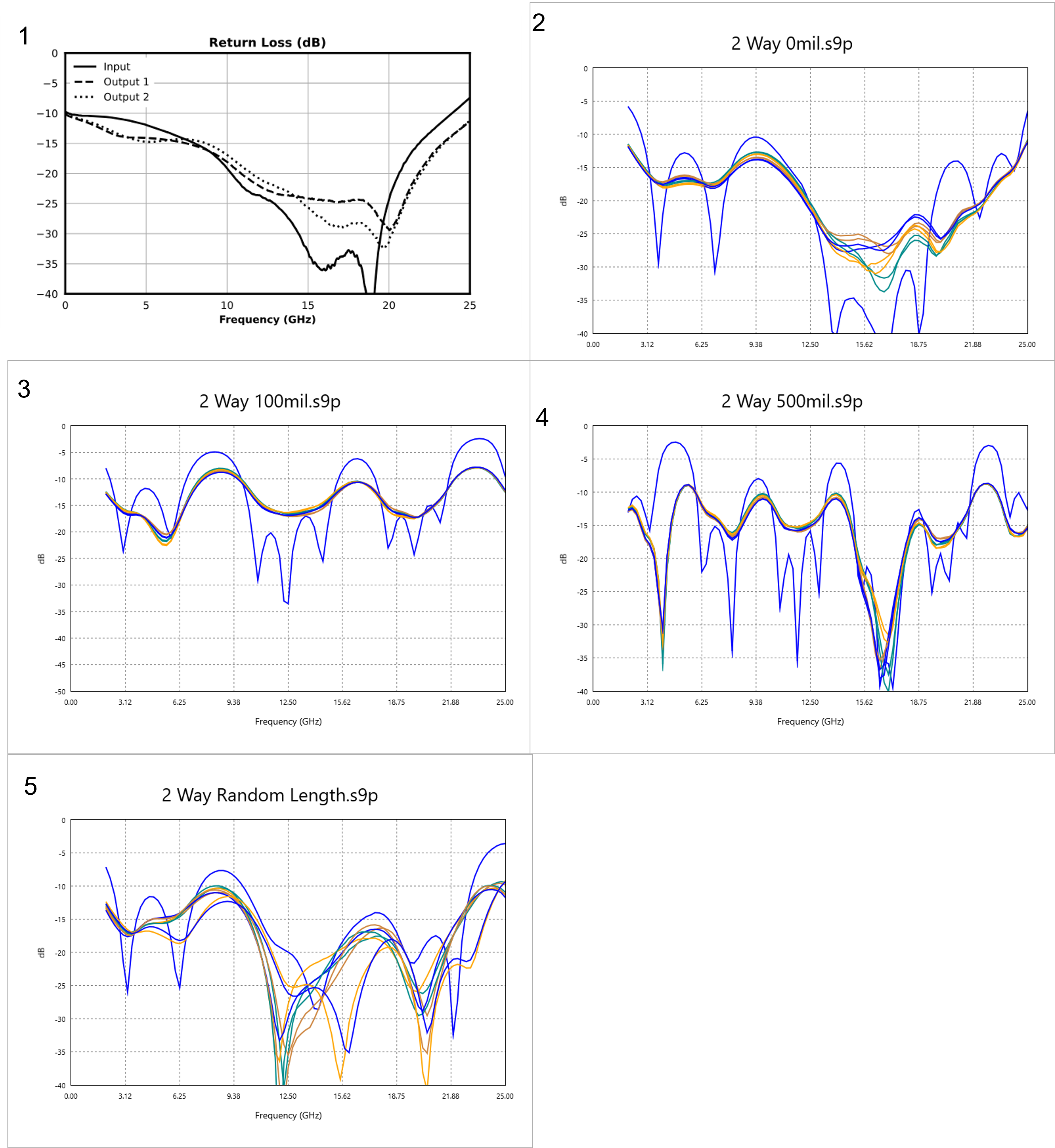
In the preceding plots the input return loss is in blue while the output return losses are in other colors. The MPD-0422FCSP2 has excellent flat return loss across the band, but especially above 10 GHz. When these are cascaded the return loss develops ripples due to standing waves (obvious in the ‘suck outs’ where the return loss drops below 15 dB). When the path length between the sections is short the standing waves have a low amplitude and the peaks in return loss are separated by several GHz. When the path lengths are longer the amplitude of the peaks becomes greater and the separation is smaller. When the path lengths are not the same the reflections no longer add together in phase, and therefore the return loss degradation is reduced. This is easier to see by looking at the voltage standing wave ratio (VSWR) for case 4.
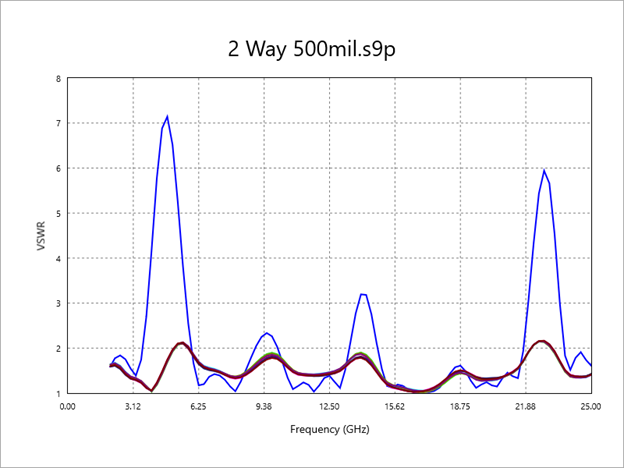
The ripples in insertion loss, therefore, come from power that is reflected from the power splitting network due to standing waves between each stage of the power divider. These waves can be mitigated by shortening the distance between each stage to the minimum possible amount (case 2), or by offsetting the distance between each power divider so it is not the same (case 5).
Now lets look at the amplitude balance of each network. To do this we will show the amplitude balance of the power divider alone, followed by a close up of the insertion loss to examine how closely each output is matched.
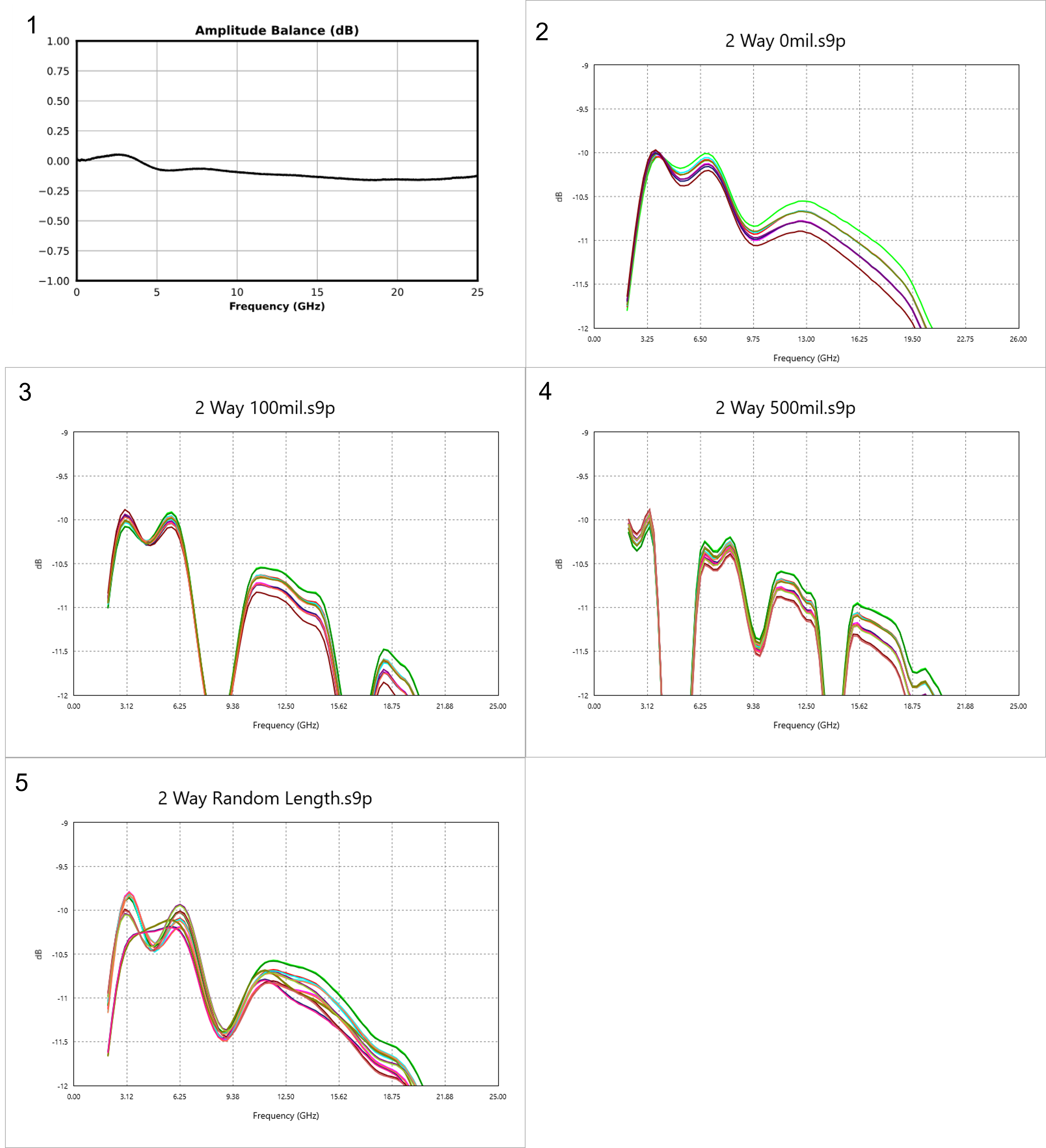
The MPD-0422FCSP2 has excellent amplitude balance of less than 0.25 dB. However when this is cascaded three times, that leads to a worst case amplitude balance of approximately 0.8 dB at 20 GHz. This is basically the same regardless of the spacing, although it can be exacerbated in sections where the insertion loss rapidly changing.
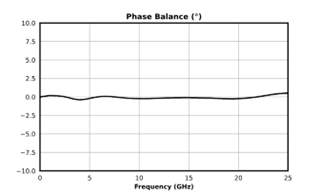
The phase balance of the MPD-0422FCSP2 is excellent, with both outputs very close to the same phase:
To consider the effect when this is cascaded we will only consider cases 4 and 5.
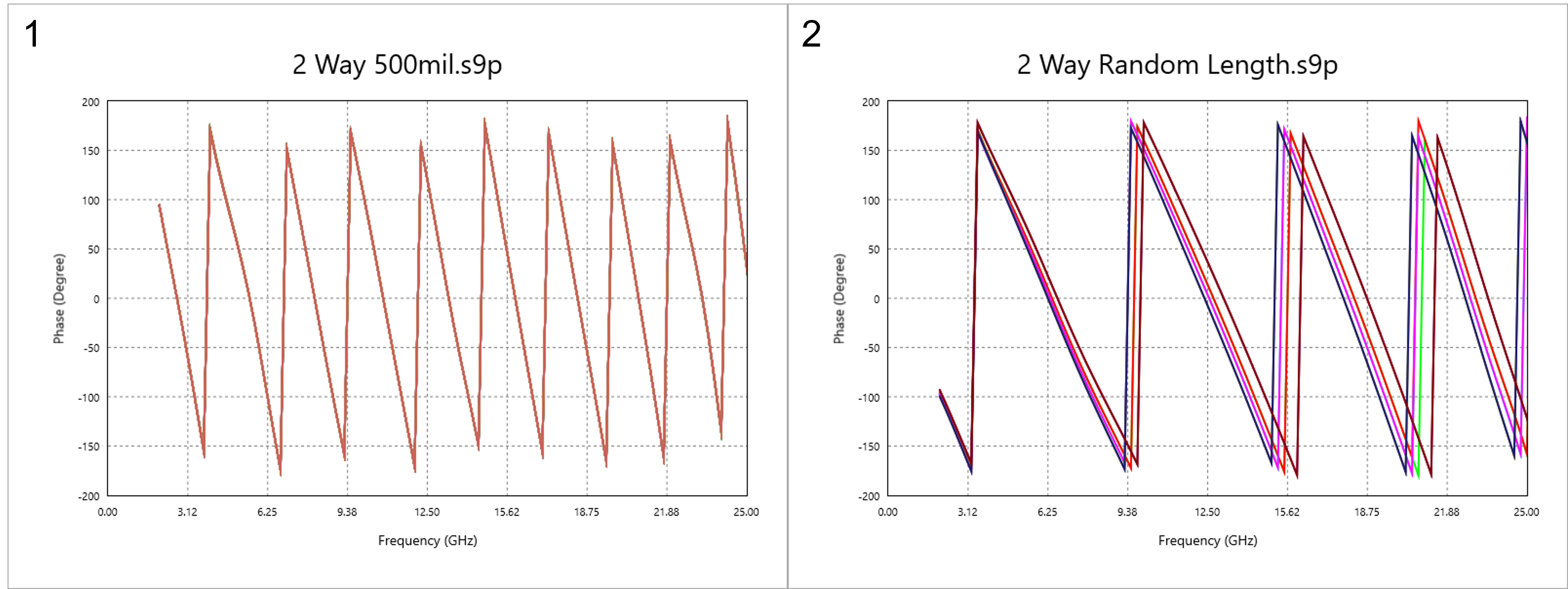
The phase balance is maintained even when the line lengths are longer and the return loss degrades. However, the phase balance is completely lost when the line lengths are random. This is the cost of having unequal line lengths between power dividers.
Finally, we’ll consider isolation. As with the other specifications, the isolation of the MPD-0422FCSP2 is excellent, better than 20 dB across most of the band. When cascaded the return loss effect causes a degradation in adjacent channel isolation from 20 dB to around 15 dB due to the mismatch on the input. The isolation between non-adjacent channels is very good due to the compounding isolation of multiple cascaded power dividers.
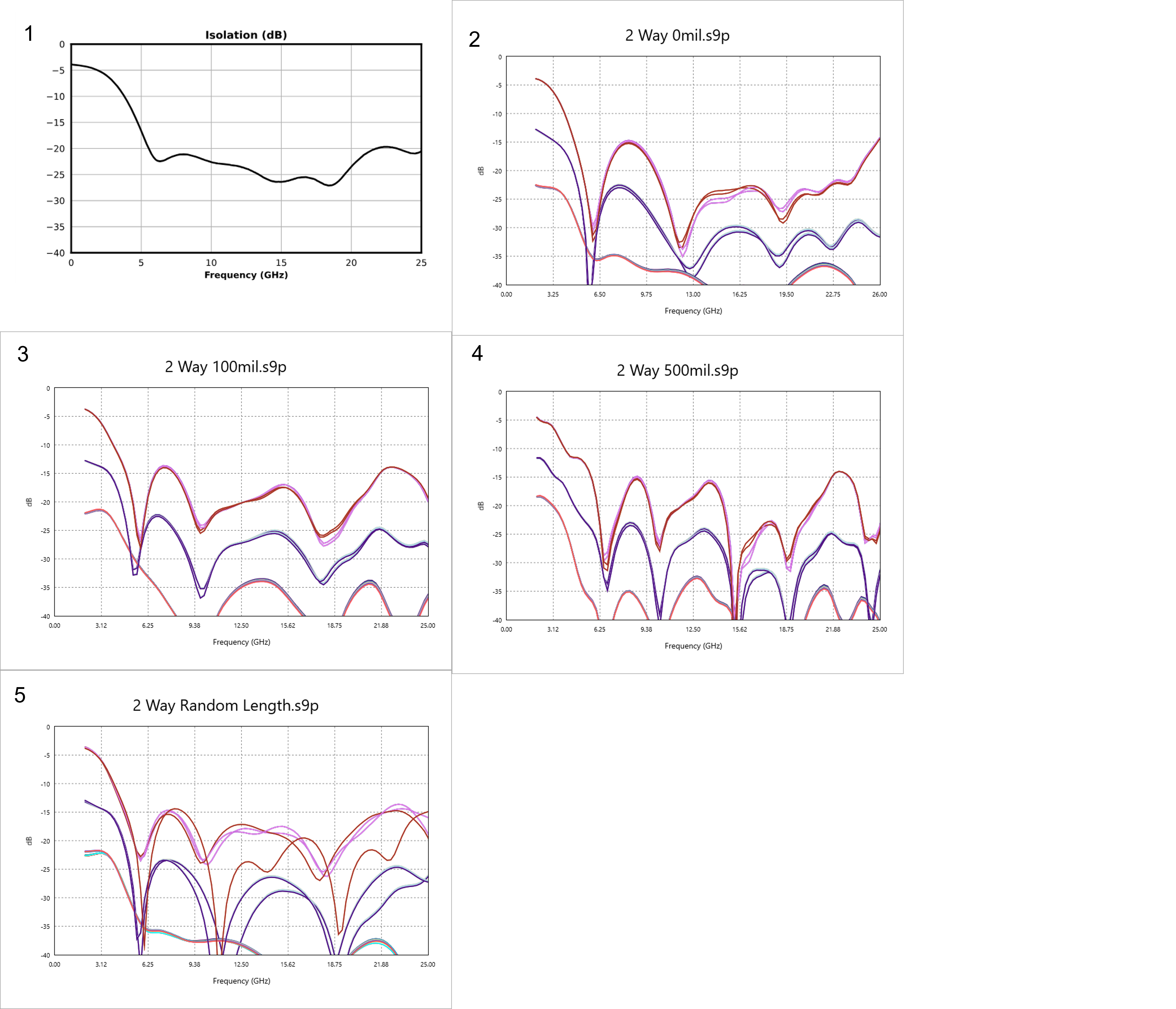
To summarize our findings:
- Cascading Wilkinson Power Dividers potentially leads to standing waves that can degrade the return loss and insertion loss
- These effect of these standing waves can reduced by minimizing the distance between them
- The effect can also be reduced by staggering the distance between dividers, at the expense of phase balance.
Next we’ll consider alternative splitters to use instead of a two way Wilkinson. For one case we’ll use a resistive power divider, the MPDR-0070CSP2. While this power divider is rated to 70 GHz, it is completely appropriate for applications of 26 GHz and below, as it has excellent performance. We’ll also look at an integrated four way power divider, the MPD4-0422CSP2. This power divider has better electrical performance than two cascaded MPD-0422FCSP2 (and much smaller size) since the entire four way divider is co-designed on a single chip.
Here are the cases we will be illustrating:
1) A cascade of 3 MPDR-0070CSP2 in series (7 total devices) with 0.1” (2.54mm) separation as the control
2) MPDR-0070CSP2 alone
3) A cascade of 3 MPD-0422FCSP2 in series (7 total devices) with 0.1” (2.54mm) separation
4) MPD4-0422CSP2 alone
5) A cascade of MPD-0422FCSP2 with MPD4-0422CSP2, with 0.1” (2.54mm) separation
6) A cascade of MPDR-0070CSP2 with MPD4-0422CSP2, with 0.1” (2.54mm) separation
Insertion Loss
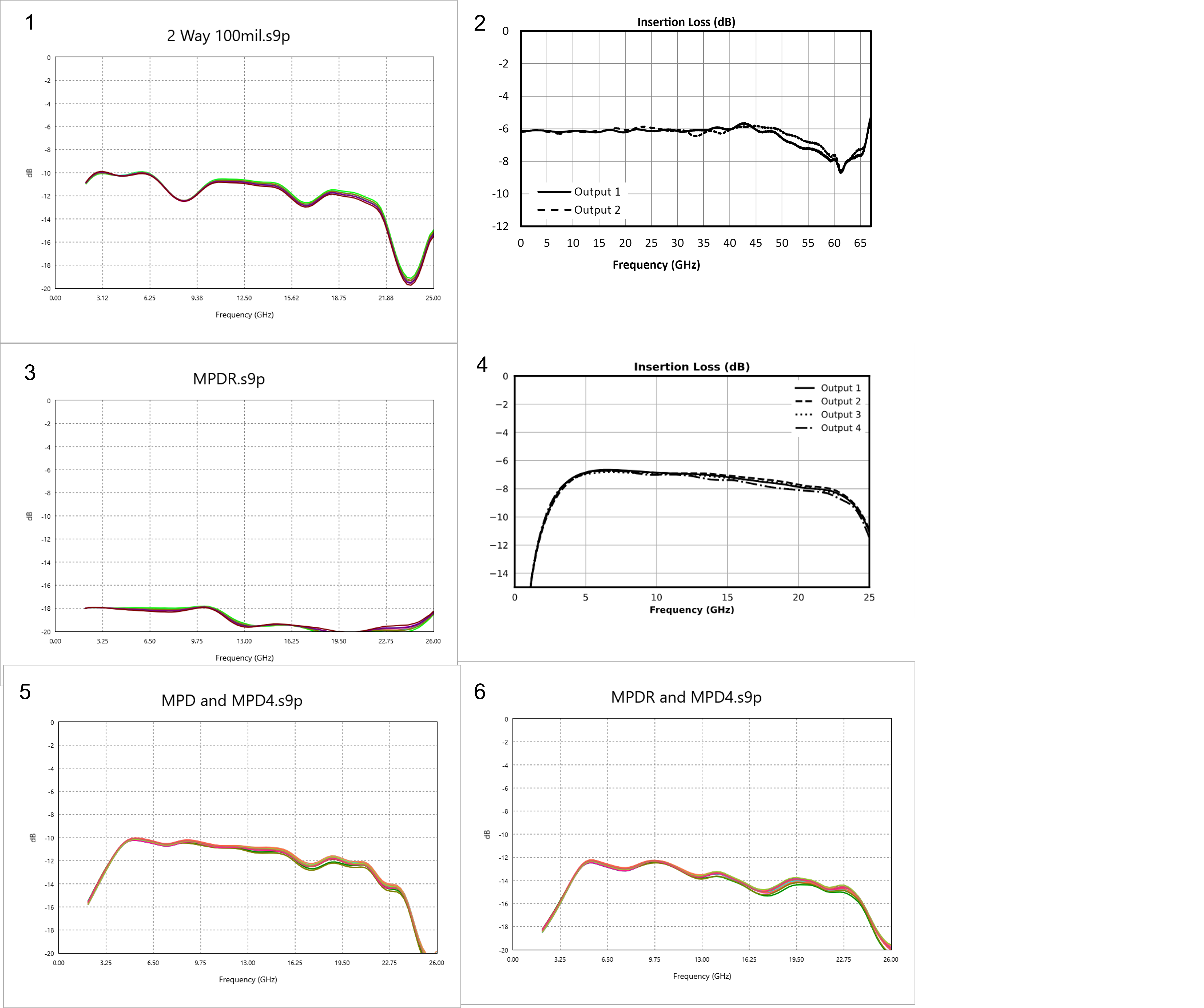
The insertion loss of the MPDR-0070CSP2 is very flat across the band (note the frequency cale extends to 70 GHz). The insertion loss of the MPDR-0070CSP2 cascade is much higher (8 dB) than the MPD-0422FCSP2. While it has less ripple, it still is not flat across the entire band.
Conversely the insertion loss of the MPD-0422FCSP2 – MPD4-0422CSP2 is both low and relatively flat. The dip around 17 GHz is still present, but significantly smaller. The MPDR-0070CSP2- MPD4-0422CSP2 cascade is very similar, but approximately 2 dB higher loss.
Return Loss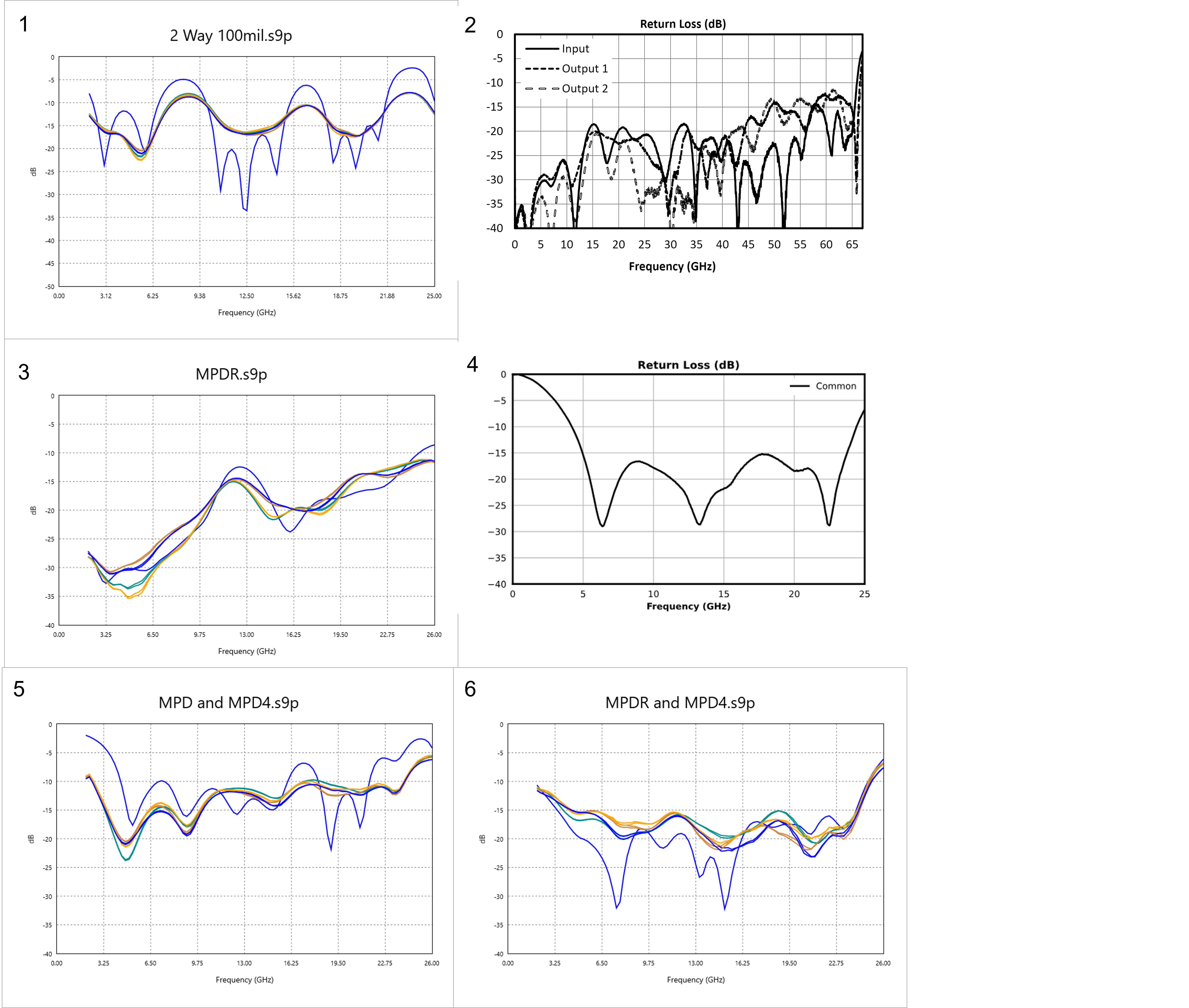
The return loss of the MPDR-0070CSP2 is excellent, and unlike the MPD-0422FCSP2 the return loss does not degrade significantly as they are cascaded. This is because the extra loss of the MPDR-0070CSP2 reduces the amplitude of the standing waves present between power dividers. The MPD4-0422CSP2 has excellent (below 15 dB) return loss across the band, and this integrated design creates a significantly better cascaded return loss than discrete MPD-0422FCSP2 alone. The MPDR-0070CSP2 – MPD4-0422CSP2 cascade is possibly the most interesting, because it trades 2 dB of insertion loss for an improvement of 15 dB return loss across the band. This may be the best of both worlds, depending on the application.
Amplitude Balance
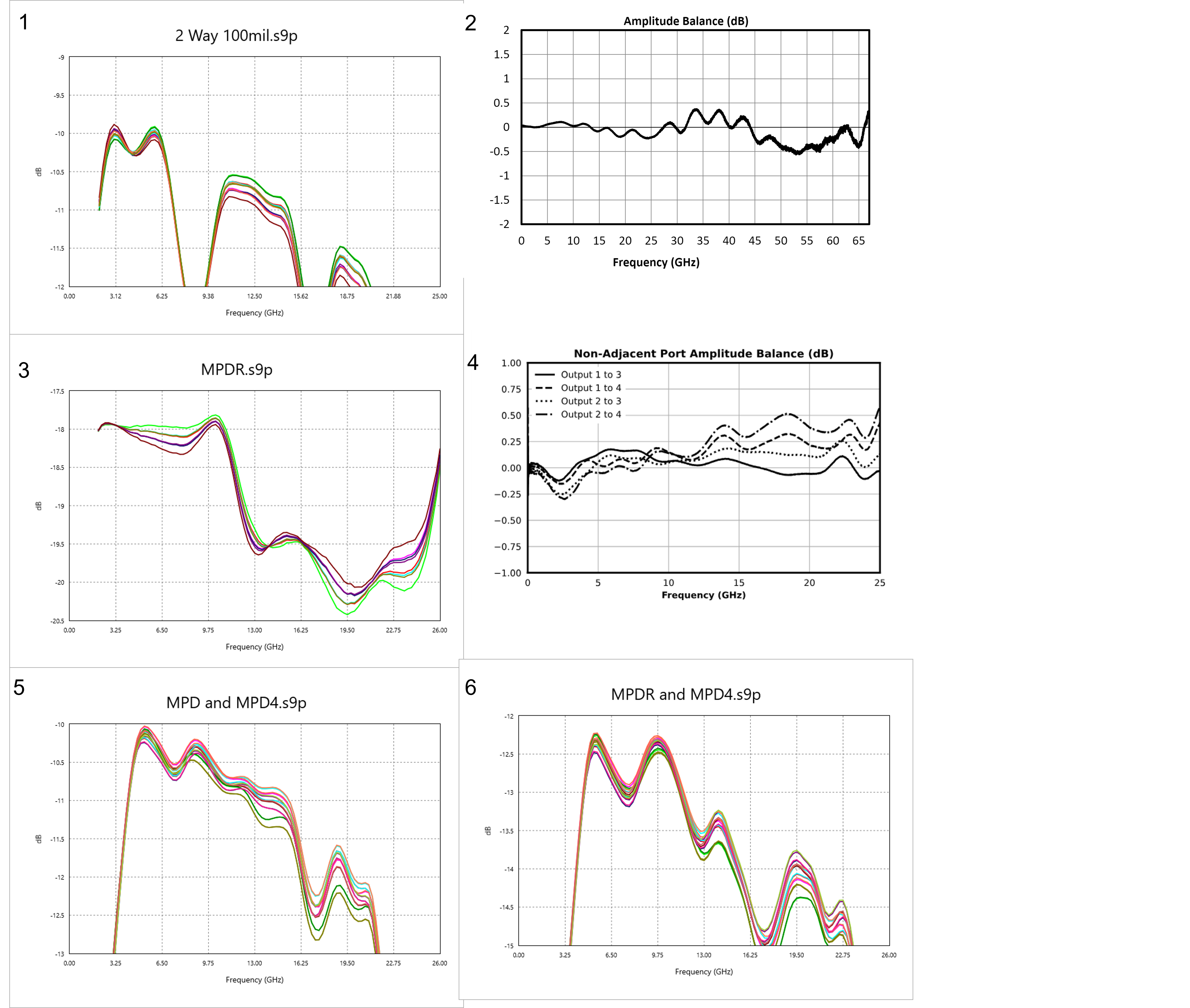
The amplitude balance of the MPDR-0070CSP2 is slightly better, and this translates to a slightly better amplitude balance of the cascaded network. However the amplitude imbalance of all cascaded power dividers leads to a predictable degradation in amplitude balance as they are cascaded to higher orders. The phase balance of each combination does not show a significant difference, so it will not be shown here. In general phase balance will be more affected by fabrication accuracy than other parameters, so it is build dependent.
Isolation
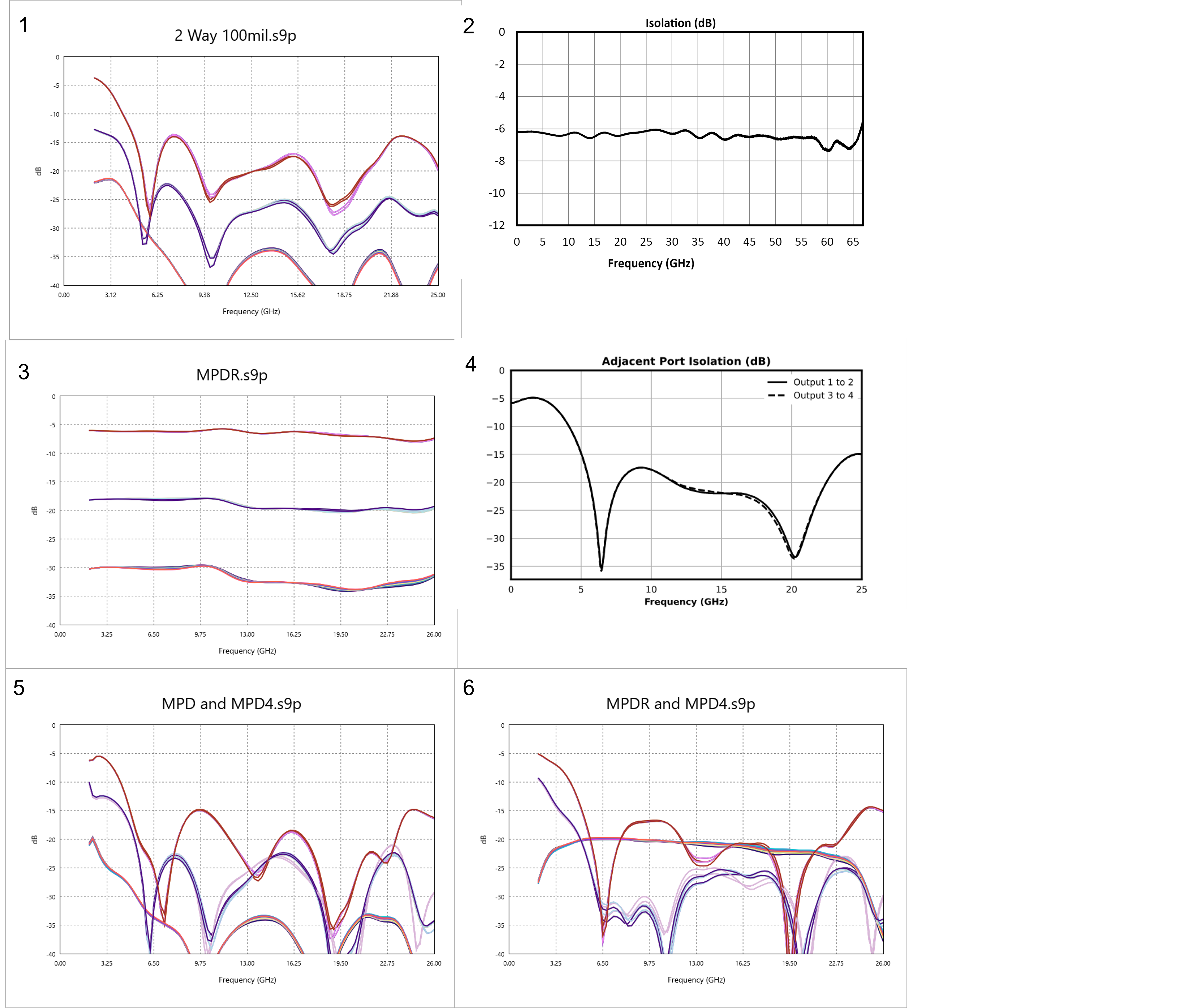
Isolation is clearly the area where the resistive power splitter lags far behind the Wilkinson power divider. The isolation of the adjacent channels is only 6 dB – the same as the insertion loss of a single power divider. A signal (or reflection) incident on one of the output ports will result in more signal passing to the adjacent channel than it will to the common port.
The isolation of the MPD-0422FCSP2 – MPD4-0422CSP2 shows a slight improvement to the isolation of the MPD-0422FCSP2 cascade alone. The big surprise is the MPD-0070CSP2 – MPD4-0422CSP2 cascade, which has superior isolation (due to matching and resistive loss) to all other alternatives.
For many applications the combination of a resistive power divider followed by a Wilkinson power divider may give a good tradeoff of loss, match/VSWR/Return loss, and isolation while preserving amplitude and phase balance.
Power Splitting with Amplifiers, Attenuators, and Equalizers
So far we have only used power dividers on their own, but with a cascade of power dividers it is possible to implement other components between stages including
Amplifiers – to provide gain, improve noise figure, and add reverse isolation at the expense of power consumption, implementation complexity, linearity, and sometimes matching
Attenuators – to provide matching and improved isolation at the expense of loss
Equalizers – to provide matching and improved isolation at low frequencies while maintaining loss and equalization at high frequencies.
In the following we will show the following simulations use the same MPD-0422FCSP2 cascade as above, but:
1) with an ADM-9028PSM implemented between the first and second stages (two total amplifiers)
2) with ATN03-0040PSM and an extra 0.100” (2.54mm) microstrip line implemented after each power divider (14 total)
3) with MEQ6-26CSP2 and an extra 0.100” (2.54mm) microstrip line implemented after each power divider (14 total)
Insertion Loss
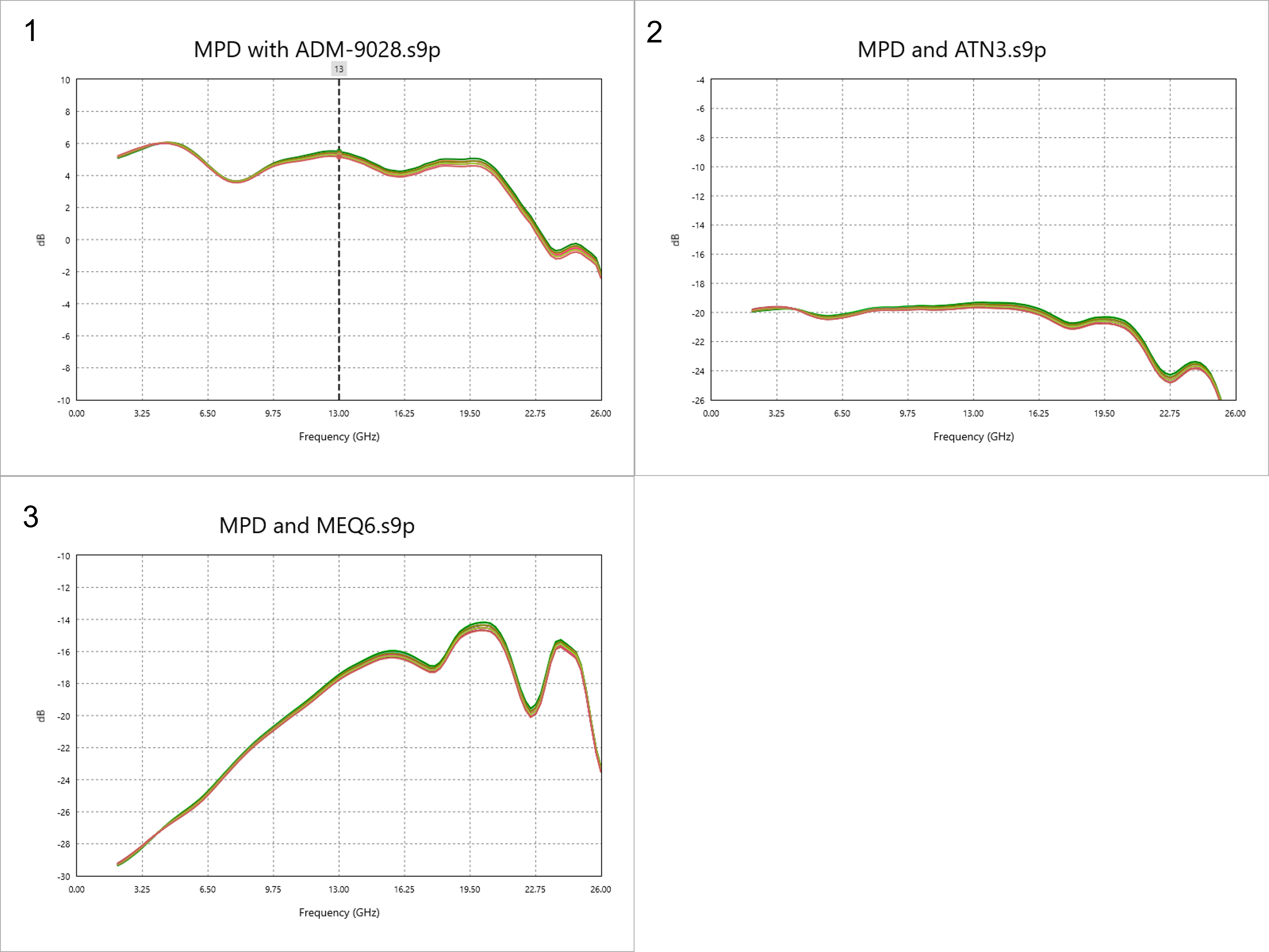
As expected, the amplifier adds a moderate amount of gain while the attenuators and equalizers add a dramatic amount of loss. The equalization value (18 dB total with 3 stages of equalizers) is clearly overkill, though it may compensate for gain slope in other parts of the system.
Return Loss
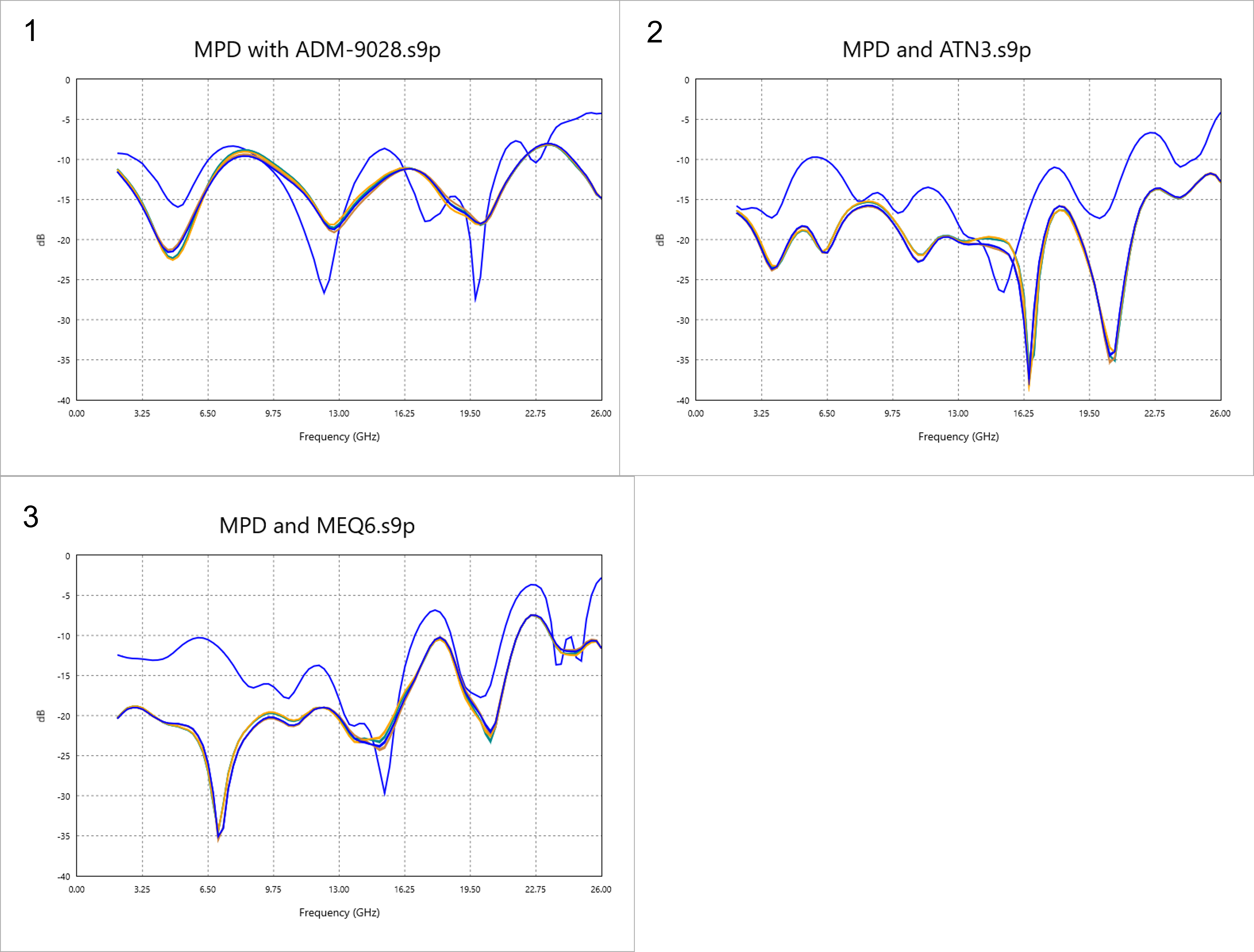
The match and reverse isolation of the ADM-9028PSM overcomes the reflections of the power divider cascade to provide decent match on both the input and output ports. As expected the addition of loss on the output ports of the power splitting network improves the match on the output, but the input return loss is surprisingly improved only minimally, suggesting that the tradeoff for adding loss may not be justified.
Amplitude Balance
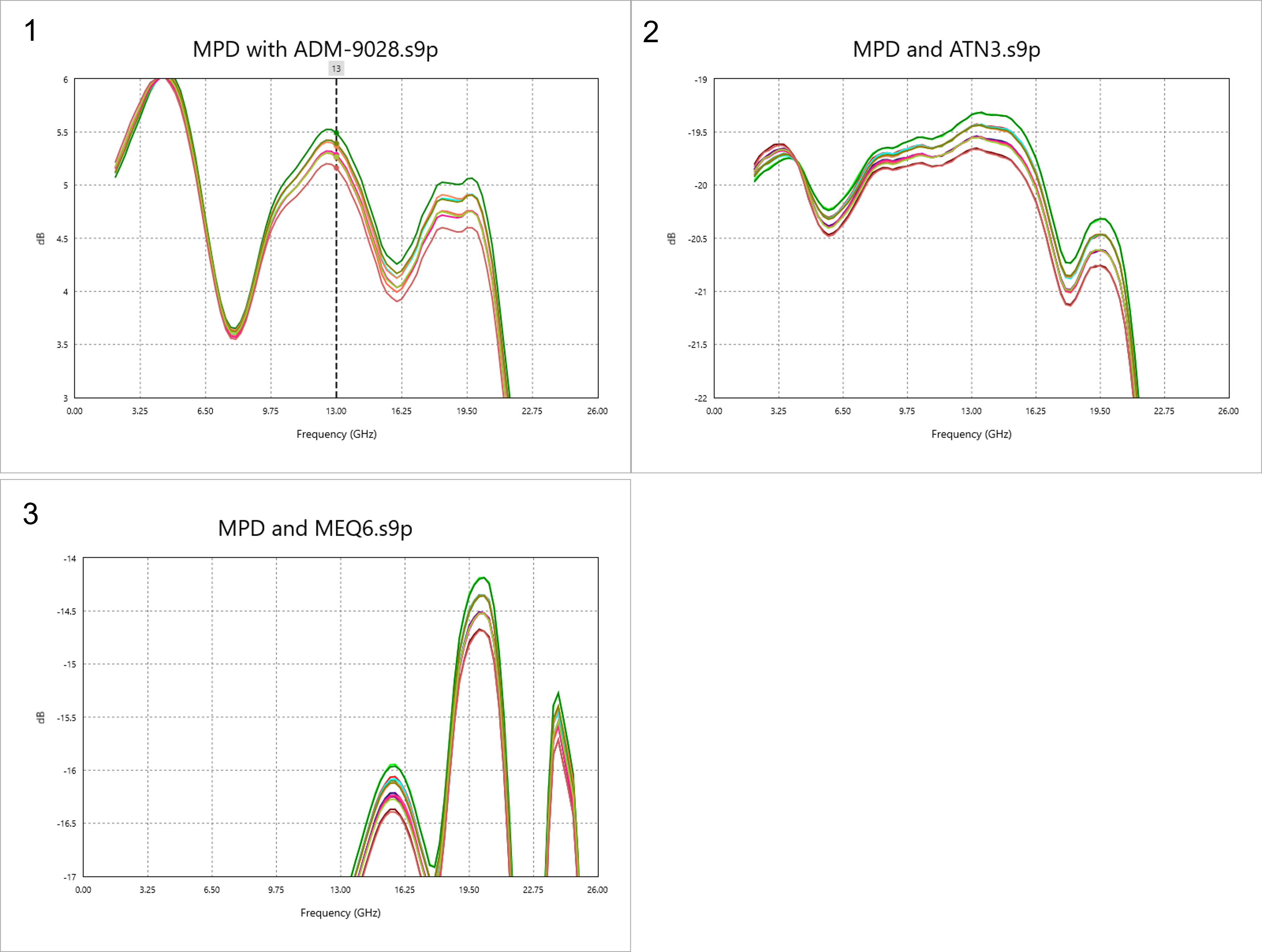
Again the amplitude balance of all options is similar, dominated by the underlying amplitude imbalance of the power divider.
Isolation
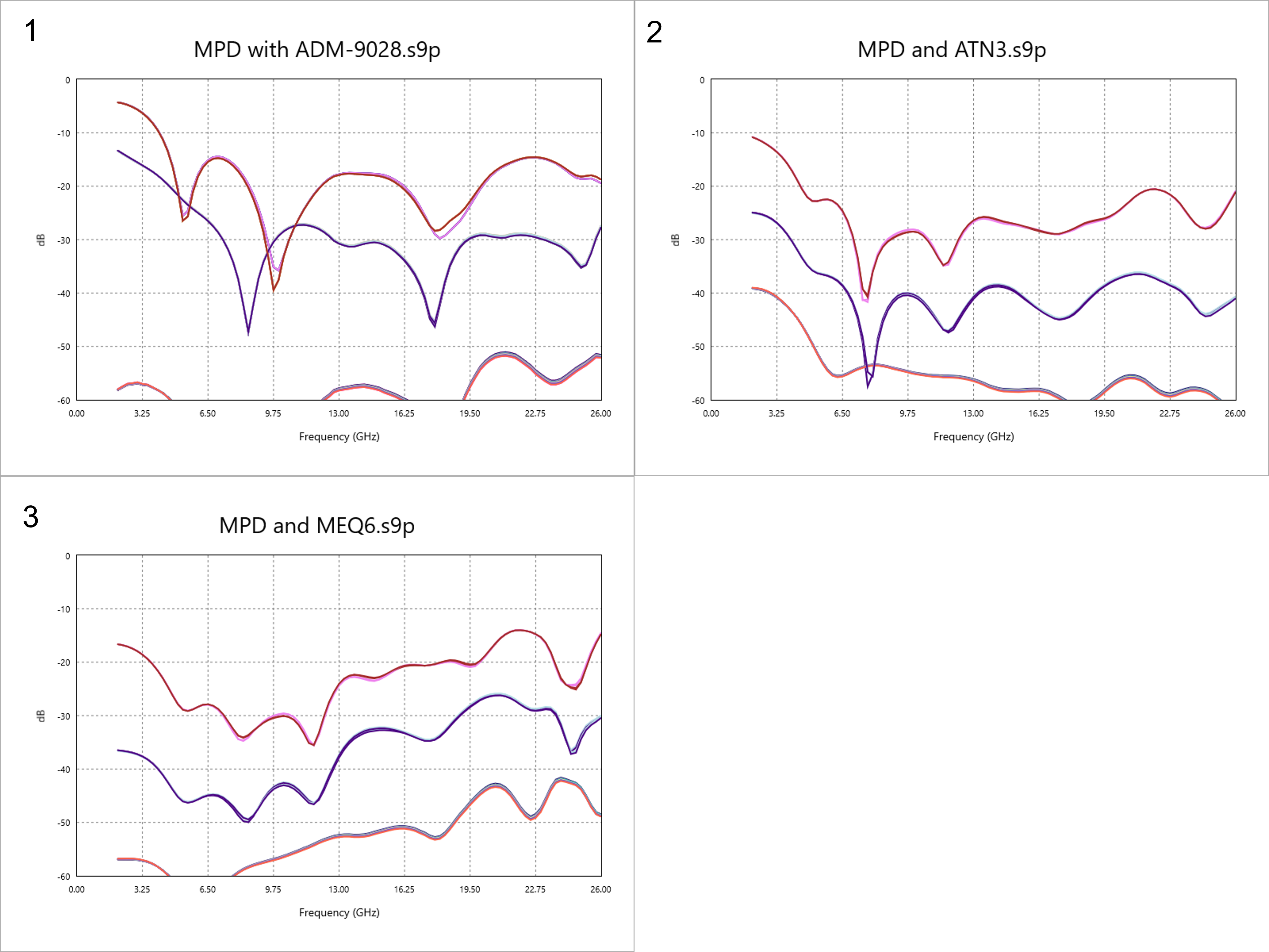
Isolation is significantly improved, particularly at low frequencies with the equalizer. This is not surprising since an additional loss of 6 dB will provide an additional isolation of 6 dB. Therefore the addition of equalization at the output of a Wilkinson network may be justified by the additional low freuqency isolation.
Additionally isolation of widely separated ports is significantly improved with the addition of either loss or the reverse isolation of the amplifiers
Reverse Isolation
A final consideration is the addition of reverse isolation for the cascade with the ADM-9028PSM. This prevents signals feeding back from the end of the power splitting network to the input.
Conclusion
In this note we have analyzed an 8 way power splitter. The data suggests the following broad conclusions:
- Cascading low loss Wilkinson power dividers, especially with long equal distances, can lead to large standing waves, which can be mitigated in various ways
- Making the line lengths uneven can reduce the standing waves at the expense of phase balance
- Using an integrated four way power divider (such as the MPD4-0422CSP2) can mitigate the standing waves at the expense of layout flexibility
- A cascade of resistive power dividers will have better insertion loss flatness and especially return loss, at the expense of significantly increased loss
- A combination of resistive power dividers with integrated four way Wilkinson power dividers provided excellent performance across all specifications
- The addition of amplifiers can improve match and distant isolation while adding gain and improving noise figure
- While attenuators and equalizers can be used to improve the matching, especially at the input and output, the tradeoff in loss may not be as beneficial as using a resistive power divider for some stages.
- Amplitude balance is dominated by the underlying balance of the power divider and will degrade with each successive stage.
Related Application Notes
Critical Grounding Issues for Microwave Amplifiers and Other RF Components
By Brian Baxter
|Published on: Tue Oct 01 2024 05:00:05 GMT+0000 (Coordinated Universal Time)
A Channelized 2-18 GHz Microwave Receiver Block Diagram
By Doug Jorgesen
|Published on: Wed Jul 09 2025 23:18:00 GMT+0000 (Coordinated Universal Time)
Filtering in Flight: Marki Filters for Satcom and Space Applications
By Madeline Pierson and Aaron Orpia
|Published on: Thu Sep 10 2026 20:24:00 GMT+0000 (Coordinated Universal Time)