Critical Grounding Issues for Microwave Amplifiers and Other RF Components
By Brian Baxter, Posted Tue Oct 01 2024 05:00:05 GMT+0000 (Coordinated Universal Time)
Download as PDF: Marki Microwave Amplifier Grounding
Introduction
The most common problems in RF and microwave systems, as well as the first thing to troubleshoot when they aren't working as expected, often arise from improper grounding. Significant cost and time savings can be had by following the guidelines in this tech note to ensure proper grounding. Due to their high-frequency operation, microwave amplifiers demand careful design, particularly with regard to grounding. While ground loops are a common issue, other grounding challenges such as improper grounding structures, parasitic effects, and EMI-induced noise can significantly impair performance.
This tech note examines the grounding issues in monolithic microwave integrated circuit (MMIC) amplifiers, including ground loops, parasitic inductance, and EMI-induced noise, and proposes design strategies such as optimizing ground planes, reducing parasitics, and implementing ground isolation to improve performance and reliability.
Addressing these challenges is critical to improving the overall functionality and stability of MMIC-based systems, especially as operating frequencies increase, and system integration becomes more complex.
What is ‘ground’ anyway?
In electrical systems, 'ground' refers to a theoretical common reference point across the entire system against which all other voltages are measured. The term ‘ground’ comes from building systems, where this is often the physical earth. In RF and microwave systems it is typically the voltage of the metal chassis that contains the circuit boards. Grounding serves multiple purposes: it provides a return path for DC current, ensures a stable reference for signals, and helps protect against electromagnetic interference (EMI) through shielding.
The idea of ‘ground’ assumes that the voltage at all ground points is the same at all times, instantaneously. This assumes that the impedance between all points referred to as ground is negligible. When we say ‘proper grounding’ we mean that the design ensures that this assumption is close enough that it does not affect the RF performance of the system.
In RF and microwave circuits, proper grounding is critical. Beyond safety concerns, a well-designed ground network:
- - stabilizes signal references by maintaining consistent impedances,
- - minimizes noise by eliminating ground loops and shielding against EMI, and
- - isolates sensitive circuits from interference.
Additionally, many ground planes also serve as heat sinks, dissipating thermal energy from high-power components such as amplifiers.
MMIC amplifier overview
MMIC amplifiers are fabricated using semiconductor processes that integrate multiple active and passive components onto a single substrate. MMIC amplifiers are widely used in high-frequency applications, including 5G telecommunications, satellite communication systems, radar, military and defense equipment, and millimeter-wave imaging. These amplifiers, which operate at microwave frequencies (300 MHz to 300 GHz), are essential for amplifying signals with minimal noise and distortion.
Ground problems in MMIC amplifiers
The characteristics that make MMIC amplifiers desirable, such as their high-frequency operation, high integration density, and compact design, also make them susceptible to various grounding-related issues. Due to their small size and high operating frequencies, physical structures and their separations on the die are often small fractions of a wavelength at microwave frequencies.
A general rule of thumb for electromagnetic coupling states that elements with parallel lengths of 0.1 wavelength or greater can effectively couple to each other. This allows for both direct coupling on the die itself as well as noise coupling from the ground plane. Consequently, MMIC amplifiers are highly sensitive to noise and signal integrity, meaning that even minor grounding problems can lead to significant performance degradation and oscillations.
This underscores the importance of proper ground network design. Marki Microwave engineers are experts in this area, utilizing circuit simulation and 3D electromagnetic design techniques to create effective ground networks for high-frequency, wide-bandwidth applications.
The remainder of this section discusses common grounding-related issues that affect MMIC amplifiers, such as ground loops, parasitics, EMI, and ground bounce.
Ground loops
When designing circuits, it's common to assume that all components connected to ground share the exact same voltage, and that the impedance between all ground points is zero. However, in the real world, these assumptions don’t hold up because of the imperfect materials used to build circuits. Variations in impedance across the ground plane and ground connections lead to differences in ground potential at different points. This creates the conditions necessary for ground loops to form.
Ground loops arise when multiple ground paths create closed loops that allow unwanted current flow due to differences in ground potential. These loops are particularly problematic for MMIC amplifiers because their small chip size and high sensitivity to noise (due to the high gain of the transistors inside), this means that even minor ground loops can have a significant impact.
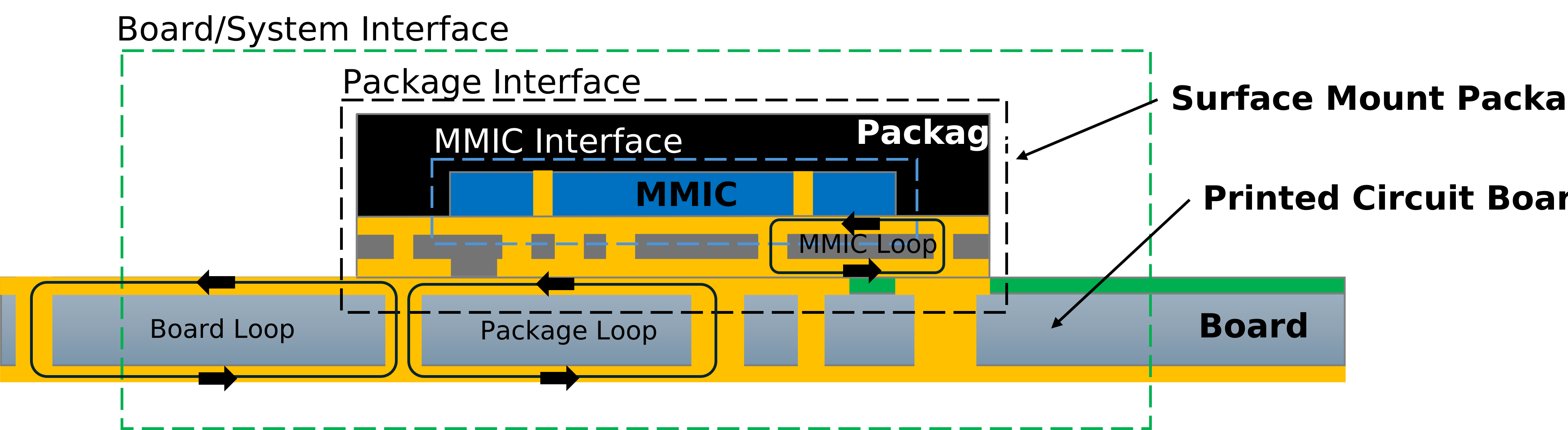
In MMIC designs, small differences in ground potential can form between the chip and package or between the package and PCB and generate ground loops. These unwanted currents can increase the overall noise floor and degrade phase noise, return loss, and linearity.
Ground loops also have the potential to cause oscillations in amplifiers due to creation of un-intentional feedback paths.
Parasitic inductance and capacitance
At microwave frequencies, even the smallest physical structure can introduce parasitic inductance and capacitance, affecting grounding. Parasitic inductance in ground connections can result in voltage differences between ground points, making it difficult to maintain a consistent reference across the amplifier. In MMIC amplifiers, parasitic inductance is particularly problematic at bonding wires, vias, and ground plane connections.
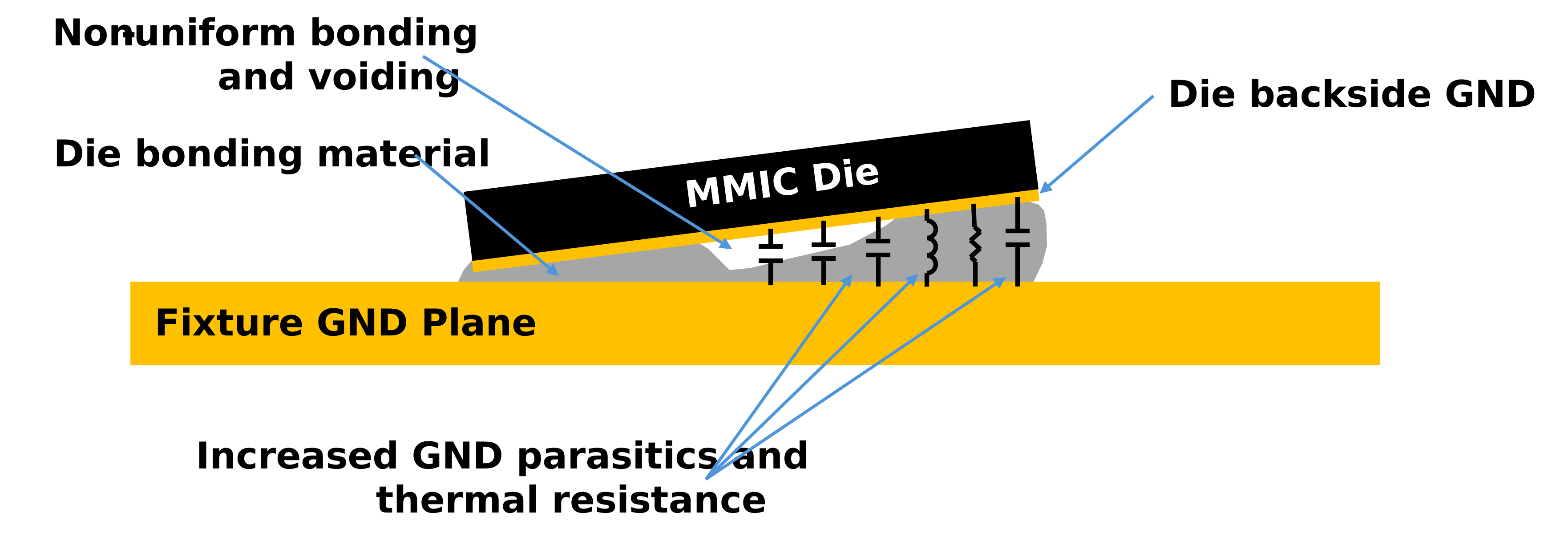
Bonding Wires: The inductance of bonding wires used to connect the MMIC chip to the package ground can introduce phase shifts or oscillations, especially at high frequencies.
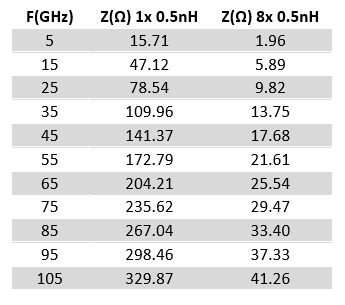
Vias: Vias connecting different layers of the PCB to ground may introduce parasitic inductance, which becomes significant in high-frequency applications. This inductance can cause the ground to "float," reducing the effectiveness of the ground plane as a stable reference. To illustrate the issue, the table below shows impedance vs. frequency for both a single 0.5nH inductor and 8 0.5nH inductors in parallel. Note how quickly the impedance increases with frequency and also how this is mitigated by the use of more parallel connections.
Parasitic Effect on MMIC performance
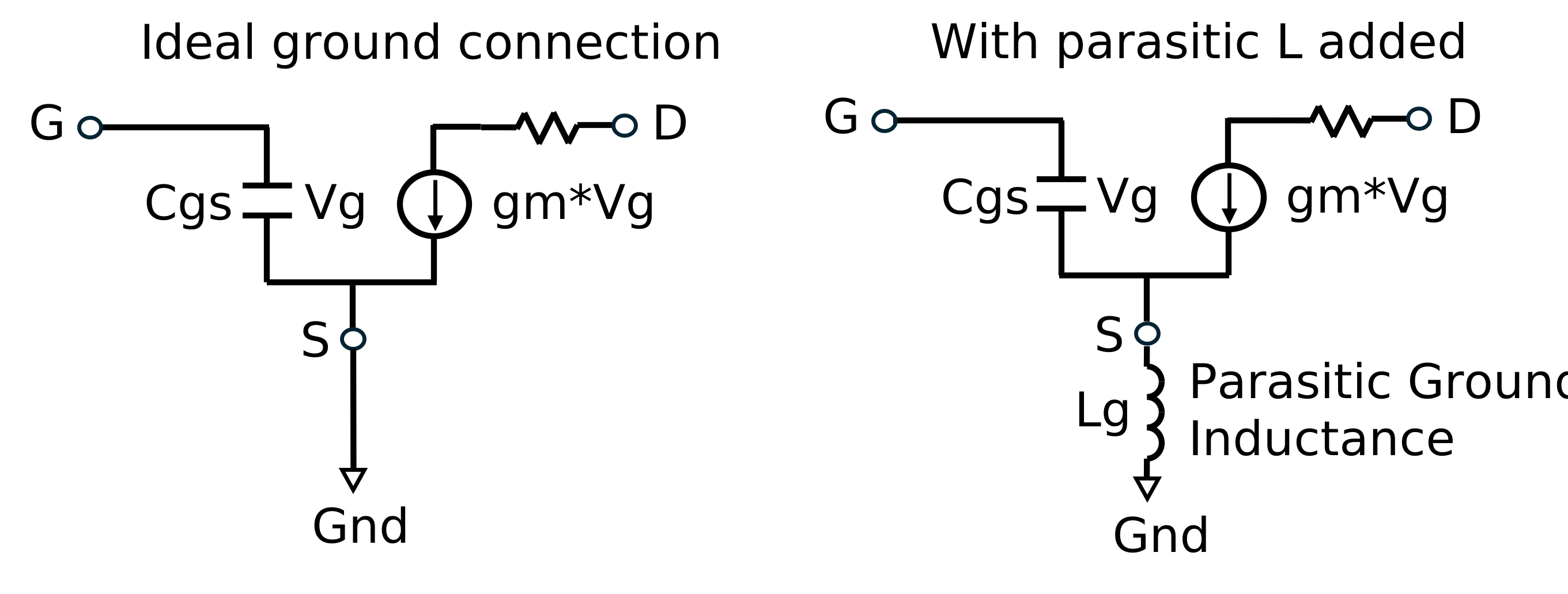
Parasitics can shift the impedance matching of the amplifier, increase insertion loss, and degrade power efficiency. In MMIC power amplifiers, parasitic inductances in grounding (shown in the figures below) can lead to uneven current distribution and localized hot spots, reducing amplifier lifetime.
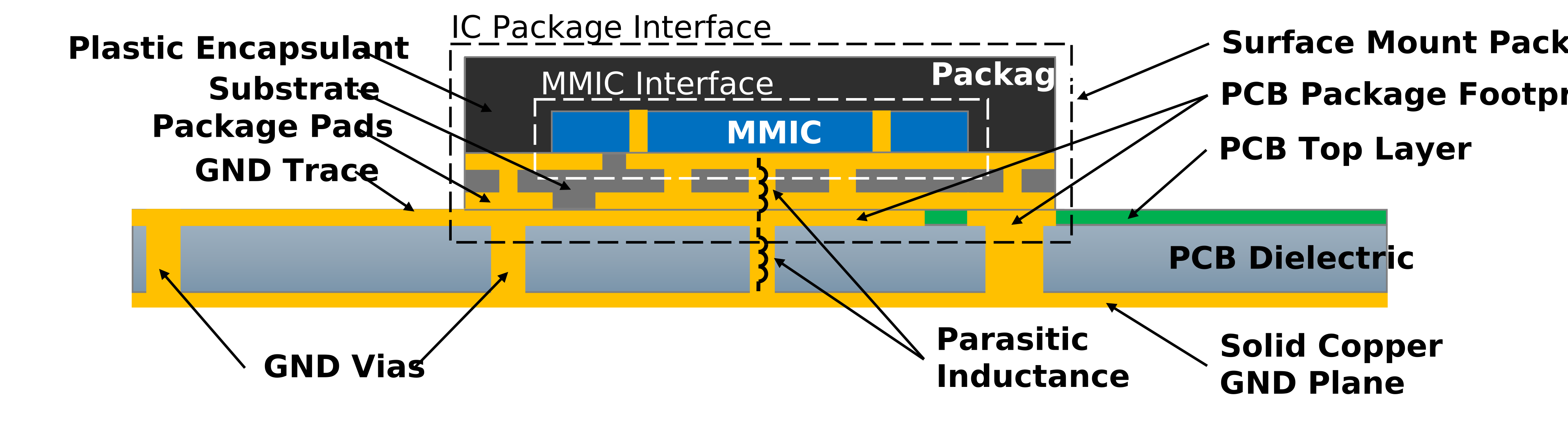
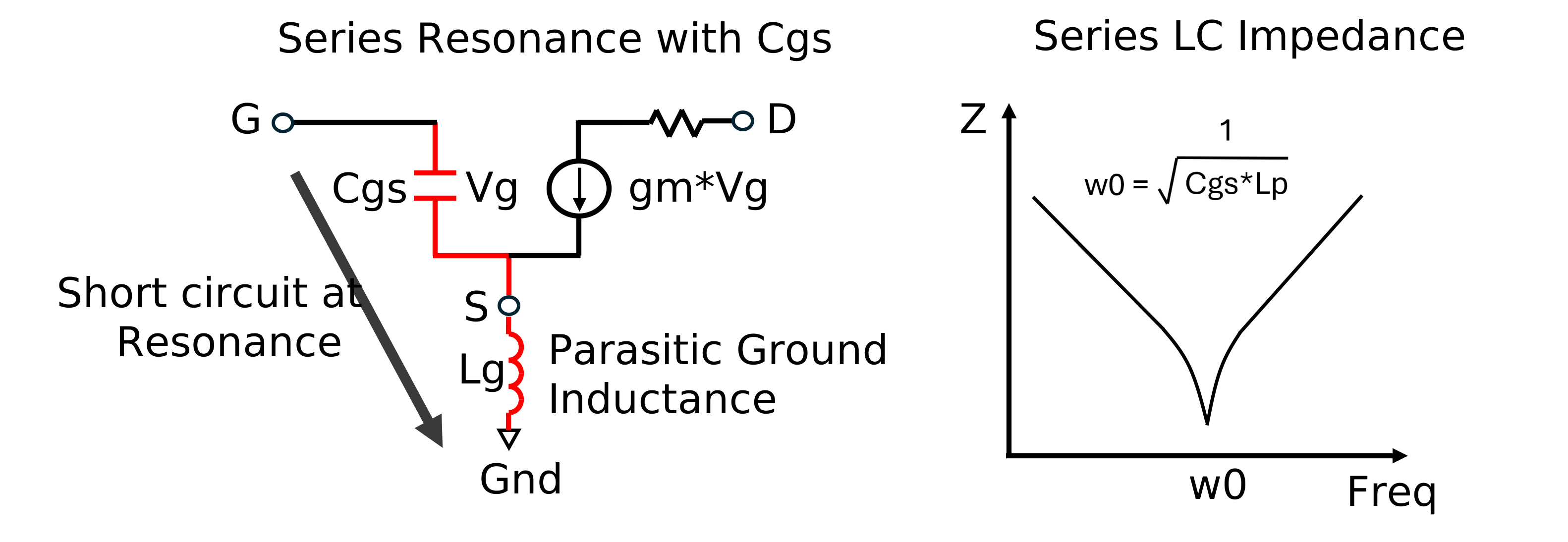
Parasitic inductance in ground vias can also create resonances that lead to oscillations. The simplified small signal pHEMT model shown below illustrates resonances can occur between the ground inductance and parasitic elements within the transistor devices. In the case below, the ground inductance is shown resonating with the gate-to-source capacitance Cgs, resulting in a short circuit to ground at the resonant frequency. This can cause oscillations due to high current flow and impedance mismatch at the input of the device. The frequency of resonance is estimated by the well-known formula shown below.
EMI coupling
Electromagnetic Interference (EMI) can couple into the amplifier’s ground plane, particularly when grounding is poorly designed (as illustrated above). Ground traces or planes that form loops are especially vulnerable to radiated EMI coupling. Other mechanisms include crosstalk, where adjacent traces couple through mutual inductance, and the antenna effect, where the ground plane acts like an antenna receiving (and potentially transmitting) EMI. Regardless of the coupling method, an unstable ground reference can result. This can cause spurious signals, signal distortion and an increased noise floor in the amplified output.
Ground bounce
Ground bounce is a phenomenon where the reference voltage fluctuates rapidly, often caused by sudden current changes. This is particularly common in digital circuits but can also affect microwave amplifiers due to their high-speed operation and potential for large current transients. Factors contributing to ground bounce in microwave amplifiers include power-on/off sequences, abrupt changes in signal levels, and high-frequency switching.
Impact of ground bounce on MMIC amplifiers
Ground bounce can severely impact microwave amplifier performance, especially in systems requiring precise timing. Rapid voltage fluctuations introduce jitter and phase noise, leading to signal distortion. This is caused by power supply noise coupling, device instability, and parasitic variations due to ground bounce. Bias point instability, resulting from reference voltage fluctuations, can also cause variations in gain, compression point, and noise.
Mitigating grounding issues in MMIC amplifiers
Effective design of ground networks can mitigate the grounding issues described above. Key strategies include ground plane optimization, minimizing parasitic inductance, ground network modeling, implementing shielding and ground isolation.
Ground plane optimization
A poorly designed ground plane can lead to significant performance issues in MMIC amplifiers. In microwave systems, the ground plane serves as the signal return path. Any discontinuities, breaks, or high impedance in the ground plane can introduce signal reflections, resulting in signal integrity problems.
Avoid ground plane fragmentation
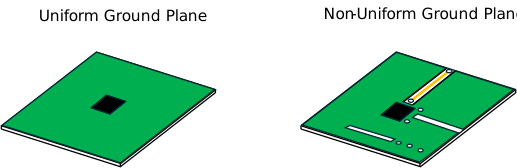
Designers should ensure that the ground plane is continuous and minimize the number of physical cuts, slots, or vias, that could lead to fragmentation. Fragmentation of the ground plane can lead to current crowding, where ground currents are forced through narrow paths, increasing ground impedance. This can cause signal degradation or unwanted electromagnetic radiation from the amplifier circuit. The figure below shows an example of a uniform top layer ground plane vs a non-uniform ground plane. The non-uniform example illustrates areas of ground plane slots, cuts and interruptions due to vias. While these features cannot be completely avoided, careful placement in the layout can help minimize their effect on performance.
Minimize return path impedance
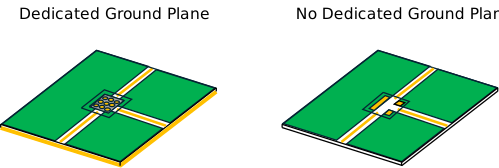
At microwave frequencies, the signal return path impedance must be as low as possible. An inadequate ground plane design increases return path impedance, causing a degradation in insertion loss and return loss of the amplifier. Using multi-layer PCBs with dedicated ground planes can help reduce parasitic inductance and ensure a low impedance return path for signals. If a dedicated ground plane is unavailable, ground connections should be consolidated to a single point as much as possible. This is often referred to as ‘Star’ or ‘Star Point’ grounding due to the physical appearance of the ground point in the circuit.
The figure below illustrates the difference between a board with a dedicated ground plane and a single layer board. The layout of the board with top-layer-only grounding results in three separate ground paths. On the board with a dedicated ground plane, the ground connections are concentrated below the device, providing a more direct and low impedance return path for the entire circuit.
Minimizing parasitic inductance
Reducing parasitic inductance is crucial for optimizing amplifier performance. Using short, wide bonding wires or adopting flip-chip techniques that eliminate bonding wires altogether can significantly decrease inductance. Additionally, minimizing via length and strategically placing them near signal paths (minimizing trace lengths) can further reduce this parasitic effect.
Modeling ground networks
We discussed how ground loops result from a breakdown of the assumption that the ground plane has a completely uniform electrical potential and impedance. As is always the case, real-world devices contain non-idealities. The impact of these non-idealities can be minimized by incorporating them into circuit simulations during the design phase. By incorporating ground parasitics into the circuit design from the start, the circuit can be properly optimized before problems arise. An example of this would be a co-simulation of a MMIC circuit, IC packaging and printed circuit board with each interface modeled.
Shielding and filtering
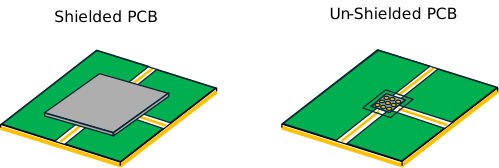
Proper shielding can help protect MMIC amplifiers from electromagnetic interference (EMI). Shielding the entire PCB or specific sections, like the MMIC package, can prevent external noise from coupling to the ground plane. However, shield effectiveness is compromised by any openings or gaps in the shielding or ground periphery.
Multilayer boards offer a significant advantage for shielding, as signals can be routed internally, avoiding discontinuities in the ground shield. Additionally, low-pass filters or ferrite beads on power supply and signal lines can effectively reduce high-frequency noise.
Ground isolation
Ground isolation is a valuable technique for system designers, especially when dealing with boards containing high-power and low-power components. By separating the grounds for different parts of the circuit, you can effectively mitigate ground loops and reduce the susceptibility to ground bounce.
For components that experience high currents or switching transients, isolating their grounds can help minimize their impact on nearby components. This can break ground loops and confine ground bounce to specific areas of the circuit.
When ground isolation is required, it is common practice to use star grounding configurations as described above. Star point grounding allows sensitive circuits access to a common ground point that is isolated from other high power, and noisy ground points. This does result in more than a single grounding point, but allows sections of the circuit with common characteristics to be better isolated from each other. This results in an overall improvement in performance.
A case study in ground network troubleshooting
RF and Microwave systems are not the only systems sensitive to proper ground network design. Audio systems can also suffer from poor grounding.
In one such case, a tube-style guitar amplifier was producing excessive hum (output noise) at low volume. As the volume was increased, the hum transitioned to a pulsating tone or oscillation. After the oscillation began, the amplifier would need to be fully powered down to stop the oscillation.
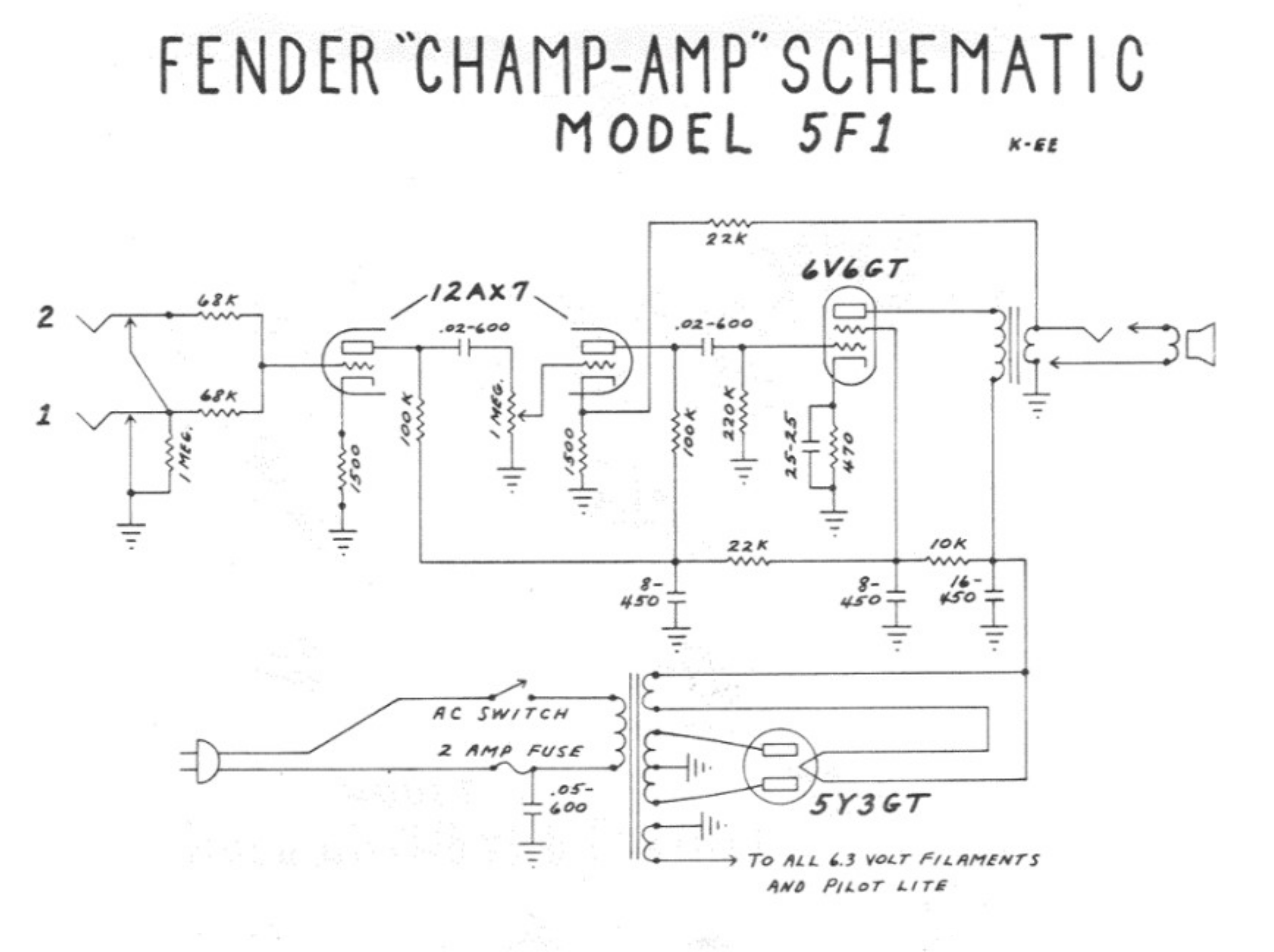
Examination of the schematic (shown above) did not reveal any issues or obviously faulty wiring in the hardware. In fact, the hardware grounding was meticulously designed in the star-point configuration. As mentioned above, this configuration is known to reduce ground loops and provide consistent ground references for the entire circuit. Despite this arrangement, excess noise was present at the output.
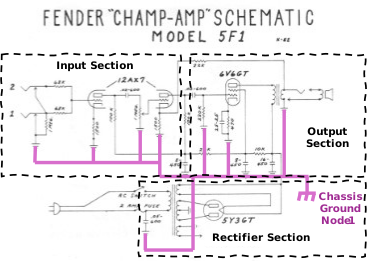
Further examination of the schematic revealed multiple stages of amplification. This amplifier is divided into three gain stages. The first two stages form a high-gain “pre-amp” and the third “output” stage provides higher power to drive a loudspeaker. In addition to the gain stages, the hardware also had a high voltage rectifier output connected to the same ground point on the chassis. The associated ground network is illustrated in the figure above.
To summarize, the amplifier had a sensitive high-gain low-power section that was potentially being influenced by other noisy high-power sections that were all connected to the same chassis ground node. This scenario could benefit from the implementation of ground isolation.
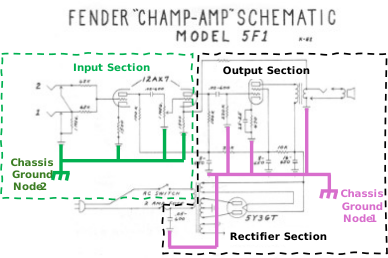
Ground isolation dictates that the high-power noisy sections should have a separate ground node from the sensitive high-gain input sections. With this in mind, a second chassis ground node was added. The pre-amp and input jacks were attached to this new ground node and the output stage and rectifier remained on the original node. This new arrangement is shown in the figure above.
Thankfully for the amplifier’s owner, this new arrangement provided the necessary ground isolation and the annoying hum and oscillations were eliminated.
Conclusion
Grounding issues, including ground loops, parasitic inductance, and EMI, present significant challenges in the design and implementation of microwave amplifiers. Proper grounding techniques are essential to ensure the performance and reliability of these amplifiers, especially as operating frequencies and integration densities continue to increase. By addressing these challenges through improved ground plane design, shielding, and parasitic minimization, engineers can mitigate grounding-related problems and enhance the overall functionality of microwave systems. Marki Microwave engineers have extensive experience in this area and carefully consider the design of ground networks on all Marki products to help reduce the chance of encountering ground issues in your systems.
Please see the links below for additional tech notes related to microwave amplifiers:
Choosing the right bypass caps for your rf power amplifier
Why are bias-tees necessary for broadband microwave RF amplifiers
Introduction to microwave amplifiers part-1: Microwave amplifier applications
Introduction to microwave amplifiers part-2: Figures of merit
Related Application Notes
The Best Way To Achieve an Unequal Power Split
By Doug Jorgesen
|Published on: Thu Sep 26 2024 00:30:00 GMT+0000 (Coordinated Universal Time)
Noise Figure and Receiver Sensitivity Explained: Practical RF Design for Low-Noise Systems
By Doug Jorgesen
|Published on: Thu Sep 04 2025 22:49:00 GMT+0000 (Coordinated Universal Time)
Filtering in Flight: Marki Filters for Satcom and Space Applications
By Madeline Pierson and Aaron Orpia
|Published on: Thu Sep 10 2026 20:24:00 GMT+0000 (Coordinated Universal Time)
Comment
Mathew Shaham, Sat Nov 16 2024 00:26:25 GMT+0000 (Coordinated Universal Time)
I believe Critical is spelled incorrectly (critial), otherwise great article!
Mathew Shaham, Sat Nov 16 2024 00:28:34 GMT+0000 (Coordinated Universal Time)
I believe Critical is spelled incorrectly in the title (critial) great article! (Not sure if my first one went through, thanks!)