Advantages of Marki Microwave’s tunable RF MMIC filter technology
By Brian Baxter, Posted Sat Oct 12 2024 04:54:46 GMT+0000 (Coordinated Universal Time)
Download as PDF: Marki Microwave Mfbt Tunable Filters
Introduction
Ideal tunable bandpass filters have the potential to significantly reduce the complexity and size of RF systems, but practical designs have historically faced challenges that limit their effectiveness. Existing solutions can struggle with poor out-of-band return loss, limited tuning flexibility, suboptimal SWaP-C, high complexity, or a combination of these issues. Marki Microwave’s MFBT series of tunable filters overcomes these challenges while delivering exceptional filter performance. This tech note explores the performance advantages and tradeoffs of the MFBT tunable filter architecture compared to traditional switched filter bank solutions.
What’s the bottom line?
Marki's tunable filters offer a wide tuning range, compact size, ease of use, and excellent out-of-band return loss, making them a strong alternative to technologies like switched filter banks. While switched filter banks excel in stopband suppression, passband flatness, and sharp roll-off, they involve trade-offs such as increased complexity, larger size, and less tuning flexibility. Applications that don’t require the highest Q or out-of-band suppression (offered by Marki’s fixed frequency MMIC filters) can benefit from the advantages of the MFBT series of tunable filters. The table below highlights the key differences between these tunable filter technologies.

MFBT Tunable MMIC Filter Details
Following on the success of Marki’s fixed MMIC filter designs, the company released the MFBT family of surface mount tunable MMIC filter designs in late 2023. This family of parts share a common design architecture which is essentially a cascade of tunable highpass (HP) and lowpass (LP) filters. The existing family of parts are primarily differentiated from each other by the frequency ranges they support. As of 10/2024 the supported frequency ranges are as follows:
MFBT-00002PSM: 4.5 to 16GHz
MFBT-00003PSM: 8 to 30GHz
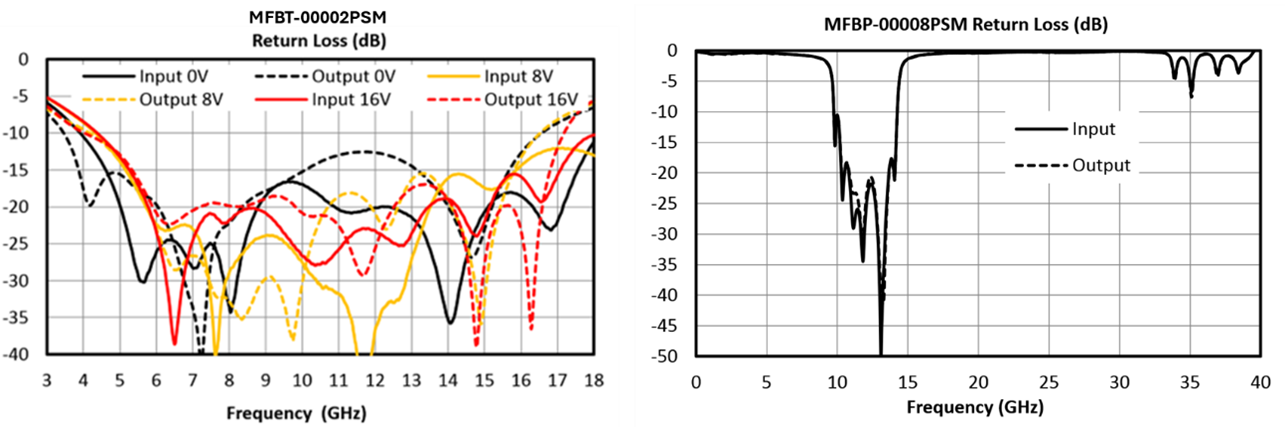
A common trait of the MFBT series is that they are reflectionless, having excellent in-band return loss and relatively good out-of-band return loss compared to other filter types. The plots below illustrate return losses of the MFBT vs control voltage and the return loss of a fixed frequency MMIC filter.
The MFBT filter series are all packaged in the same 4x4mm 20-pin QFN surface mount package, they have identical pinouts and tuning is accomplished through two analog control pins. The analog control voltages for each part are identical and range from 0 to 16V. Filter tuning is continuous through the entire voltage range with one voltage setting the low frequency corner and the other setting the high frequency corner of the bandpass filter.

Comparing MMIC Tunable and Switched Filter Bank Solutions
Marki’s MFBT tunable filters perform an RF function similar to traditional switched filter banks, but they offer multiple advantages. The advantages and trade-offs of the MFBT tunable filters are examined in more detail below.
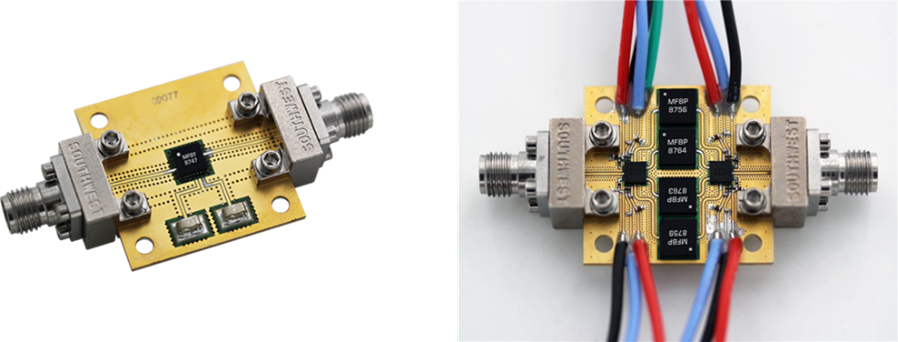
The size advantage of the MFBT filter is apparent when comparing the two solutions side-by-side. The MFBT filter takes up a small 4x4mm square on its evaluation board. As seen in the graphics below, the MFBT is over 5x smaller than the 4-state switched filter solution.

The MFBT filter offers a much simplified control arrangement versus the switched filter bank solution and does not require separate DC power supplies. The MFBT requires only two control lines (VL and VH). The switched filter bank shown below is built with commercially available SOI SP4T switches and requires up to 13 control lines (+Vdd, -Vss, Vctrl1, Vctrl2, Enable and Gnd for each switch, plus an optional logic select line). The difference can be easily seen in the photos below.
The MFBT has improved out-of-band return loss vs. the switched filter bank solution. This is due to a difference in the filter architecture between the two solutions. The plots below illustrate how the MFBT return loss stays relatively constant below -15dB regardless of the applied tuning voltages, while the return loss of one of the fixed filters used in the switched filter bank increases to almost 0dB out-of-band.

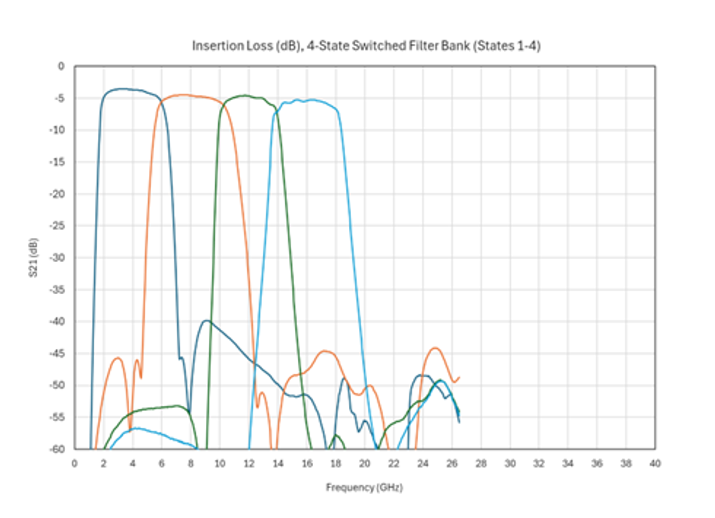
The MFBT series of filters offers a practically infinite tuning range within their operating bandwidth. The flexibility in adjusting the upper and lower filter corners means that filter response can be tailored to the application requirements. The filter can be tuned as constant bandwidth, constant percent bandwidth or arbitrarily as desired. The switched filter bank is obviously limited to the number and frequency range of its associated fixed filters. That being said, it is also obvious from the plots below that the switched filter bank has an advantage in absolute filter performance such as stop-band suppression, passband flatness and high Q.

Tunable Filter Demonstration Platform
Marki Microwave created a demonstration (demo) platform to display the tuning and filtering capabilities of both the new MFBT series of tunable filters as well as a proof-of-concept switched filter bank. The demo platform consists of hardware and software elements. The hardware elements consist of a benchtop network analyzer, DC power supplies and product evaluation boards. The software consists of a graphical user interface (GUI) and test equipment automation functions. The GUI allows convenient and intuitive interaction with the tunable filters as well as automation of the applied tuning voltages and measurement trace captures.

For the IMS2024 demo, the MFBT-00002PSM was displayed and compared against a switched filter bank (SFB) having 4 fixed filters evenly distributed across the 2-18GHz band.
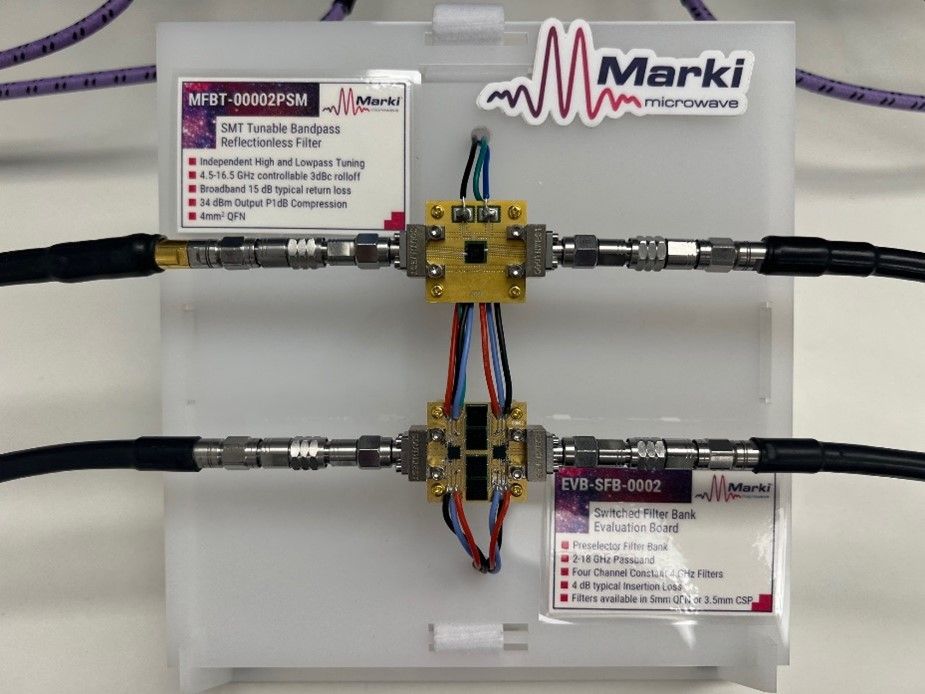
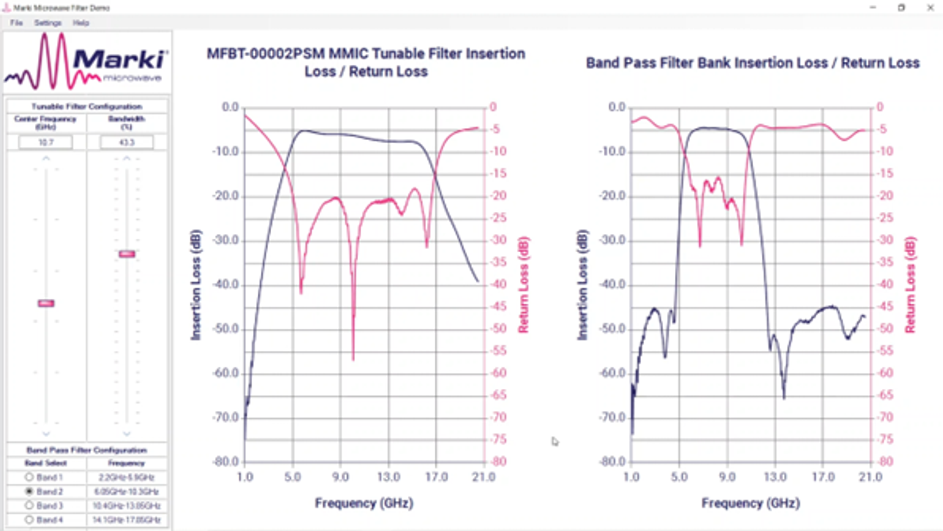
Attendees were able to immediately validate the tuning range of the MFBT filter by adjusting corner frequency, bandwidth (BW) and center frequency controls. Switched filter bank controls allowed comparison of fixed filter vs tunable filter performance across the same band of interest.
Tunable Filter RF Performance
The MFBT-00002PSM has a full 3dB BW of 4.5 to 16.5GHz with the ability to tune to center frequencies from 5.5 to 15.5GHz. It has a typical insertion loss of 6.5dB at center frequency (Fc) and typical highside out-of-band rejection of 35dB at a distance of 1.5*Fc. The MFBT-00002PSM has two tuning inputs (VH and VL) that control the HP and LP filter corners respectively. The control signal is a DC voltage that can vary continuously from 0 to 16V. Both filter corners are at their lowest points when VL=0V and VH=0V, and at their highest points when VL=16V and VH=16V.
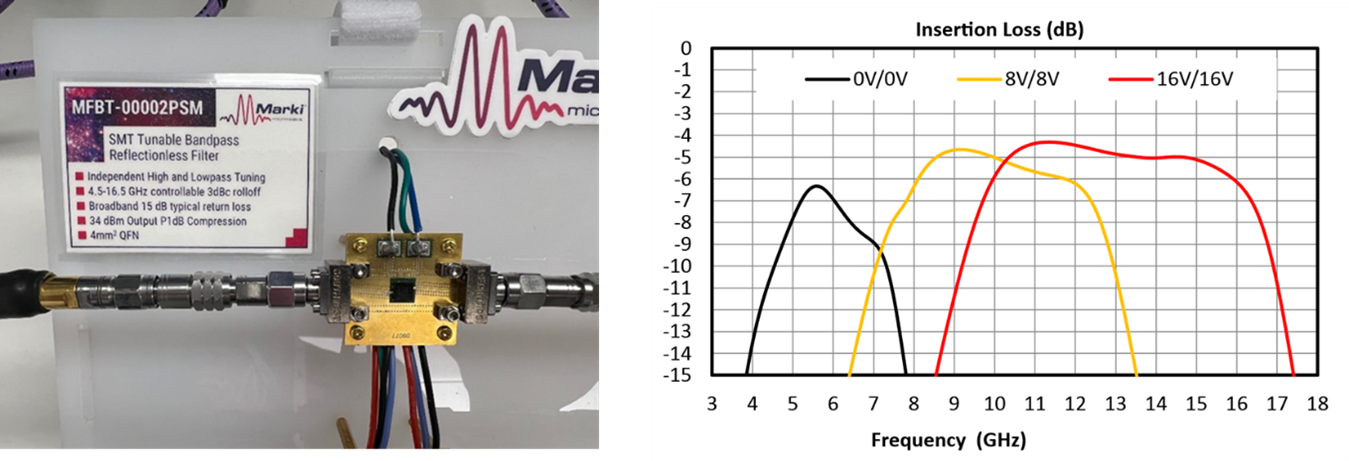
Independent corner frequency control allows users to simultaneously adjust center frequency as well as BW. It is possible to maintain a constant %BW or absolute BW across a range of center frequencies. The demonstration platform allows both center frequency and %BW control as well as direct VH and VL control voltage manipulation.
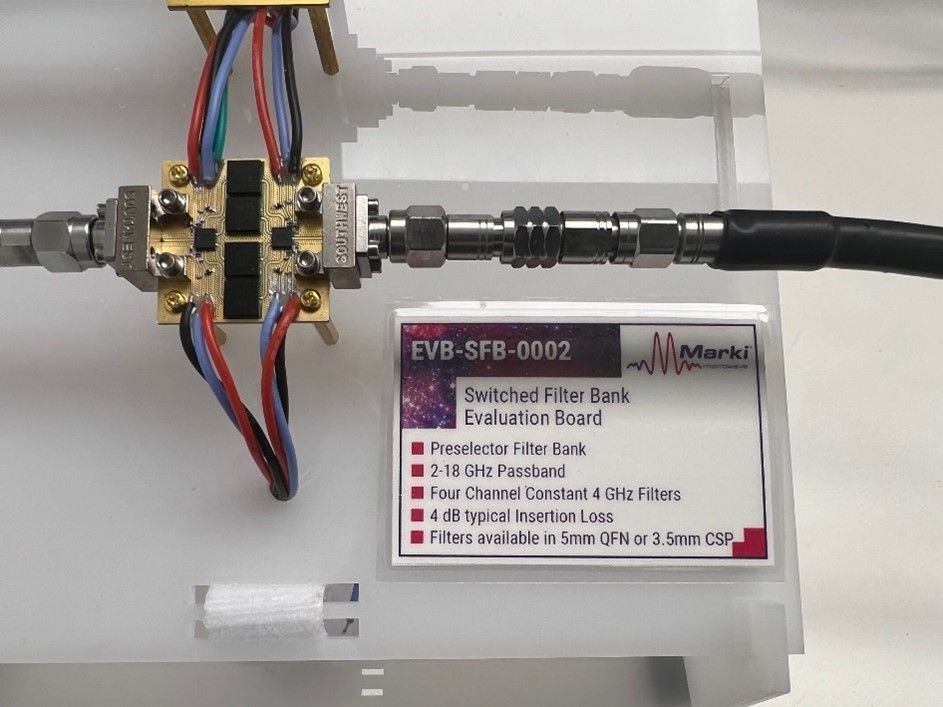
The switched filter bank demo pcb consists of four Marki fixed frequency MMIC filters and two SP4T switches. The switches used for IMS2024 were commercially available SP4T SOI switches. The Marki fixed filters were as follows:
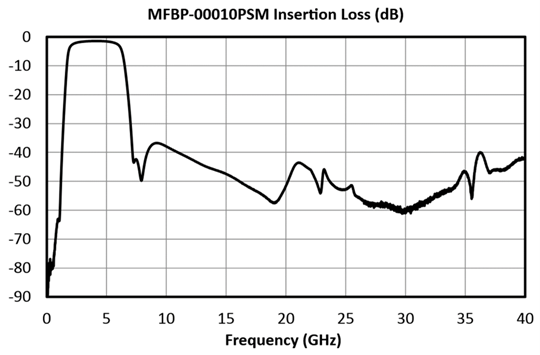
MFBP-00010PSM: 2.2-5.9GHz, 5x5mm QFN
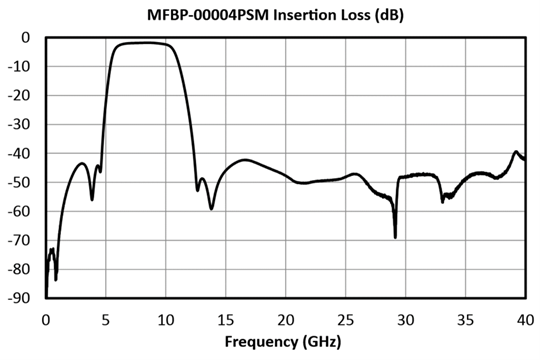
MFBP-00004PSM: 6.05-10.3GHz, 5x5mm QFN
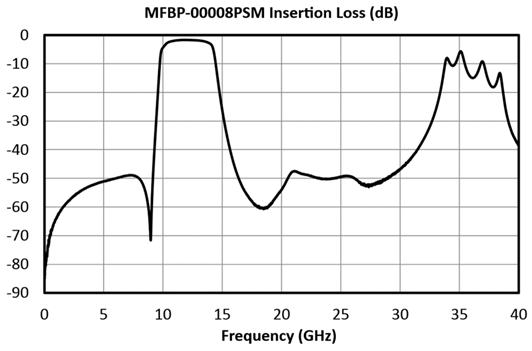
MFBP-00008PSM: 10.4-13.85GHz, 5x5mm QFN
MFBP-00009PSM: 14.1-17.85GHz, 5x5mm QFN
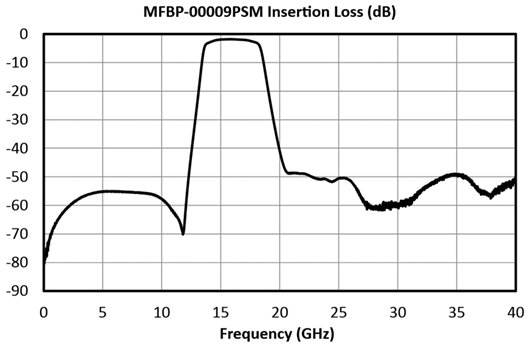
The switches and filters were aligned on the PCB and the switch logic was designed to allow selection of a single filter through path (4 filter states). The demo GUI provides switch logic control and has buttons to allow a user to select the active filter path on the PCB.
For each evaluation board, the demo software captures both insertion loss and return loss traces from the vector network analyzer. These traces are then simultaneously displayed on individual graphs, one for each product (MFBT and SFB), to allow for easy comparison of the different filtering techniques. A screenshot of the demo GUI and display is shown below.
Conclusion
Marki’s tunable filter demo platform effectively illustrates the tuning capability of the MFBT tunable filter series as well as the performance of switched filter banks built using Marki’s fixed frequency MMIC filters. Marki’s tunable filters exhibit excellent tuning range, flexibility and remarkably small size when compared to switched filter bank solutions. The SFB has a performance advantage in out-of-band rejection, passband flatness and insertion loss at the expense of greater complexity, greater size and a loss of flexibility. As usual, there is no “one-size-fits-all” solution but it’s clear whether a design requires high performance or small size and flexibility, Marki Microwave has a filter for every application.
Additional Resources:
MMIC Filter Advancements Drive New Tools
The Surprising Ways MMIC Filters Are Enabling the Development of Next Generation Systems
MMIC Filters: Revolutionizing RF Systems with Compact Design and High Performance
Related Application Notes
How to Make an RF or Microwave Power Splitting Network
By Doug Jorgesen
|Published on: Mon Oct 07 2024 23:01:00 GMT+0000 (Coordinated Universal Time)
Rules of Thumb for Designing a Landing Pattern
By Jessica Kaur
|Published on: Thu May 07 2026 21:20:09 GMT+0000 (Coordinated Universal Time)
Noise Figure and Receiver Sensitivity Explained: Practical RF Design for Low-Noise Systems
By Doug Jorgesen
|Published on: Thu Sep 04 2025 22:49:00 GMT+0000 (Coordinated Universal Time)