MBAL vs. MBALH Data
By Niki Mobtaker, Posted Wed Apr 02 2025 00:59:00 GMT+0000 (Coordinated Universal Time)
With the release of our small form factor 1:1 and 1:2 baluns, MBAL(H)-0R106/0R520CSP2, we thought it’s time to touch base on our balun types and the information we present in our datasheets. To review, our MBAL and BALs are 1:2 baluns, meaning the unbalanced/single-ended impedance is 50 ohm and the balanced impedance is 100 ohm differential/50 ohm single-ended. MBALH and BALHs are 1:1, meaning unbalanced/single-ended impedance is 50 ohm while the balanced impedance is 50 ohm differential/25 ohm single-ended. The diagrams below illustrate both balun types.

Most of our customers buy our baluns for interfacing with an ADC/DAC in their system. Impedance matching to these devices is quite difficult because its input impedance varies constantly. To support this process, most of our balun releases are offered with both ratios while maintaining identical package/footprint dimensions. This ensures our customers can easily switch between packages for the best RF performance in their system.
In RF, the most common impedance to expect is 50 ohms. And our testing systems are built around that; VNAs, calibration kits, connectors, and cables are ordered in 50 ohm for the good of most parts. So what do we do when we create and evaluate a non-50 ohm part? Well, we have no choice other than to measure in a 50 ohm system; this includes the pads/traces of the evaluation board. De-embedding does help minimize the mismatch effects, but the data will have more ripples and degradation than in a matched system. We create a matched environment by simulating an impedance transformer and back calculating the data with the impedances being matched. The figure shown below illustrates the process; we inserted the original de-embedded s-parameter data into a 3-port sNp/sub-circuit block and connected an impedance transformer to both balanced ports.
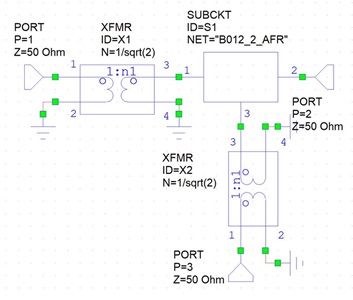
We extract this data de-embedded and that generates the plots seen on the MBALH datasheets. The same results would be produced if the balanced ports were connected straight to 25 ohm ports/terminations. Some of the MBALH datasheets include two additional plot sections to present the unmatched data: Mixed Mode Scattering Parameters in a 100 Ohm System and Typical Scattering Parameters in a 100 Ohm System.
To go along with this, we will have 4 sets of downloadable data available: typical/mixed mode s-parameters of the balun in a 50 ohm or 100 ohm differential system. We will present this with the suffix of the data file being the single ended and differential impedances, which will either be "50SE-50D" or "50SE-100D".
Below is an example of how these files are labeled for the MBALH-0R520CSP2.
- MBALH-0R520CSP2_SM_A_25C_De_50SE-50D.s3p
- MBALH-0R520CSP2_SM_A_25C_De_50SE-50D_balanced.s3p
- MBALH-0R520CSP2_SM_A_25C_De_50SE-100D.s3p
- MBALH-0R520CSP2_SM_A_25C_De_50SE-100D_balanced.s3p
Related Application Notes
Marki Microwave MMIC Amplifier Product Families Decoded
By Brian Baxter
|Published on: Fri Oct 25 2024 23:59:38 GMT+0000 (Coordinated Universal Time)
Mixed Mode Scattering Parameters: What Are They and How Do I Use Them?
By Harley Berman
|Published on: Thu Nov 21 2019 22:26:00 GMT+0000 (Coordinated Universal Time)
Filtering in Flight: Marki Filters for Satcom and Space Applications
By Madeline Pierson and Aaron Orpia
|Published on: Thu Sep 10 2026 20:24:00 GMT+0000 (Coordinated Universal Time)