IQ/IR/SSB Mixer Primer
By Doug Jorgesen, Posted Wed May 13 2020 19:00:00 GMT+0000 (Coordinated Universal Time)
Download as PDF: Iq Ir Ssb Mixer Primer
Wireless communication and radar systems are under continuous pressure to reduce size, weight, and power while increasing dynamic range and bandwidth. The quest for higher performance in a smaller package motivates the use of IQ mixers: mixers that can simultaneously mix ‘in-phase’ and ‘quadrature’ components (sometimes called complex mixers). System designers use IQ mixers to eliminate or relax the requirements for filters, which are typically the largest and most expensive components in many RF & microwave system designs. IQ mixers use phase manipulation to suppress signals instead of bulky, expensive filters.
The goal of this application note is to introduce IQ, single sideband (SSB), and image reject (IR) mixers in both theory and practice. We will discuss basic applications, the concepts behind them, and practical considerations in their selection and use. While we will focus on passive diode mixers (of the type Marki sells), the concepts are generally applicable to all types of IQ mixers and modulators.
1) What can an IQ mixer do for you?
We’ll start with a quick example of what a communication system looks like using a traditional mixer, a single sideband mixer (SSB), and an IQ mixer. The task is to upconvert two baseband signals a(t) and b(t) to be transmitted within limited available bandwidth and without transmitting in adjacent bands. The two signals could be separate channels or the same information broken into two streams. The problem is that a standard mixer will create both upper and lower sidebands with redundant information in them. To create a single sideband signal using a normal mixer we upconvert the signal and then use an image rejection filter to remove the redundant sideband from the signal (1A).
The separation between the desired signal and the unwanted signal is equal to the input signal frequency, requiring an expensive filter with very sharp cutoff. One can ease the filter requirements by increasing the input signal frequency at the cost of a more expensive and power hungry baseband circuitry, or using a superheterodyne architecture.
An upconversion using a single sideband mixer (1B) achieves the same result, but with no filter! There are many complications to the actual implementation that we will discuss later, but the basic idea is that you can accomplish the same task by manipulating the phase of the signals that would otherwise require a filter. Consider a more complicated example, where we fill the available bandwidth directly using an IQ mixer, with no filtering or suppression (1C).
Using the IQ mixer has some important differences over the previous examples. Instead of putting b(t) into a higher bandwidth channel on the same IF input, we put it in the same channel bandwidth but on a separate IF input Q. We move the LO from the edge to the middle of the available bandwidth. Both siganals are converted using a double sideband upconversion into the same RF bandwidth in this case, and neither sideband is suppressed. However, the two data signals have a phase difference, so they can be separated at the receiver on the basis of this phase difference, as long as both sidebands are transmitted. Again no filter is required, and in this case the IF circuitry has half the bandwidth as in the single sideband upconversion example. There is one more similar example to consider. A single sideband mixer incorporates an IF hybrid coupler (implemented digitally or in analog circuitry). If the ports of this coupler are used simultaneously, then the upper and lower sideband can be generated simultaneously (1D).
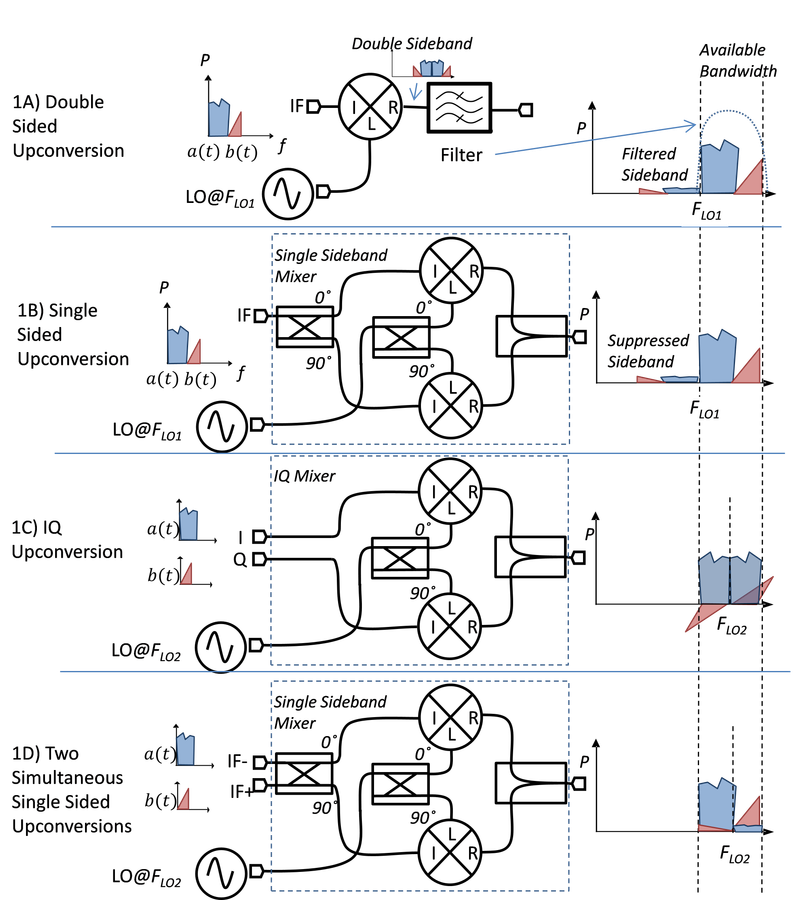
This has the benefit of low bandwidth IF circuitry and also does not require phase discrimination in the receiver. In the following sections we’ll look at the internal circuitry of the IQ and single sideband mixer, and its downconverting equivalent the image reject mixer. We’ll discuss the practical implementations of this circuitry and look at other implications to the performance of a microwave system.
1) How does an IQ, image reject, or single sideband mixer work?
The fundamental principle behind IQ, IR, and SSB mixers is signal cancellation through phase manipulation. These mixers create two copies of the desired signal that are in phase with each other and two copies of the undesired signal that are out of phase with each other. When these are combined the undesired signal is canceled, leaving only the desired signal. This is analogous to how a double balanced mixer creates isolation by creating in-phase and out-of-phase copies of the LO and then combining them, but done with quadrature hybrids instead of baluns. Let’s track the path of the desired sideband in a single sideband mixer to understand how this concept works. First, the structure of a single sideband mixer:

To create a single sideband, first the IF data signal is split into two copies with a 90˚ phase shift between them. The LO is also split into two copies with a 90˚ phase shift between them; one copy is applied to what we’ll call the in-phase mixer and one to quadrature phase mixer. This is the critical step, since the two sidebands inherit the phase of the LO differently. The frequency (and hence the phase) of the upper sideband is the sum of LO and IF frequencies, while the frequency (and phase) of the lower sideband is the difference of the LO and IF frequencies. Thus, the phases add for the upper sideband and subtract for the lower sideband. In the in-phase mixer, both sidebands have a 0˚ phase shift. In the quadrature mixer the two 90˚ phase shifts add to become a 180˚ phase shift on the upper sideband and subtract to become a 0˚ phase shift on the lower sideband. When the signals are recombined in the in-phase power combiner the upper sidebands will cancel and the lower sidebands will add together.
Several important things to note:
1) Two quadrature shifts can be applied in many combinations to create signal cancellation, leading to IQ and Image Reject mixers.
2) Dynamic range of the circuit is limited not only by image rejection or sideband suppression, but also by LO isolation and other spurious products defined by other figures of merit. These other isolations and mxn spurious products are all affected (typically improved) by the way they inherit 0˚, 90˚, or 180˚ phase from the structure.
3) Each of the functional blocks can be realized in many different ways (including digitally). This leads to numerous permutations on the basic concept depending on desired system tradeoffs.
4) Bandwidth can theoretically be limited by the quadrature hybrid on the IF, the quadrature hybrid on the LO, the power divider, or the mixer. Practically, it is almost always limited by the quadrature hybrid.
5) Image rejection is limited by the phase and amplitude balance of the circuits
We’ll explore each of these points in more detail in the following sections.
3) What are the differences between an IQ/image reject/and single sideband mixer?
Above we described the operation of a single sideband mixer, which upconverts a signal to a single sideband while suppressing the other sideband. The downconverting equivalent is an image reject mixer, which downconverts one sideband while rejecting the undesired (or ‘image’) sideband. The circuit structure (identical but operated reciprocally from the single sideband mixer) is shown below.

Similar to the single sideband mixer, the image reject mixer functions on the principle that the phases add differently when converting RF-LO and converting LO-RF. Even if no signal is present at the image frequency, the image reject mixer can improve system performance by rejecting the noise power in the image frequencies.
The IQ mixer is similar in structure, but eliminates the IF hybrid. Each phase of the RF signal can be recovered separately from the I and Q ports at the receiver, or a different signal can be applied to the I and Q ports for transmission.
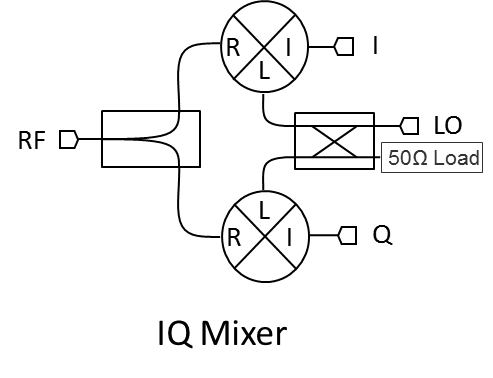
One input is converted with an in-phase LO (the I input) and one with a quadrature phase LO (the Q input). These are combined at the RF for broadcasting. At the receiver, a second IQ mixer can demodulate the I and Q signals separately. This only works, however, if both sidebands are transmitted and the LO has the same relative phase as the transmitting LO. If one sideband is filtered then cancellation will not occur. If the LO is not phase locked then the undesired signal will not be suppressed. This illustrates a weakness of IQ modulation relative to single sideband modulation, in that the phase of the carrier must be recovered in order to separate the I and Q signals.
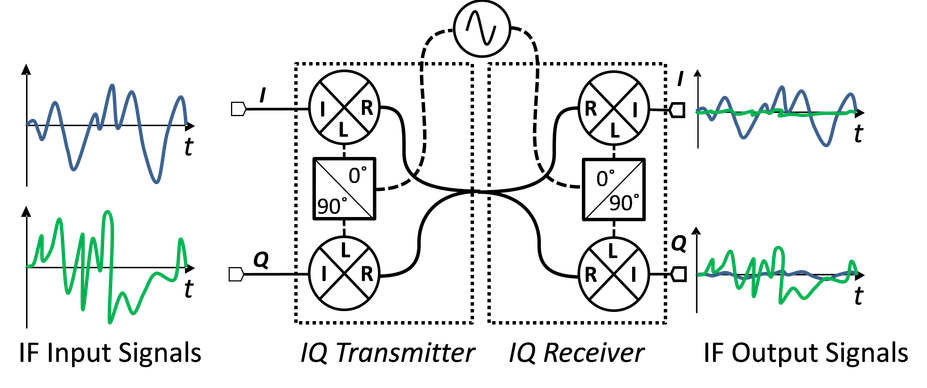
In each of the above examples you can see that two quadrature phase shifts are combined to get signal cancellation through a positive and negative version of the undesired signal. There are other ways to achieve this goal (through a quadrature hybrid on the RF port instead of the LO, for example), but there are practical reasons related to the subcomponents of the IQ mixer that make these the most common. Before discussing these practical reasons, we need to define exactly what it is that we are trying to optimize for in an IQ/IR/SSB design.
1) Figures of Merit
An IQ, IR, or SSB mixer is subject to the linear and nonlinear mixer figures of merit discussed in the Mixer Basics Primer including conversion loss, single tone intermodulation distortion, multi-tone intermodulation distortion, VSWR/return loss, P1dB, and isolations (LO to I/Q, RF to I/Q, and most importantly LO to RF).
Additional figures of merit measure how close the matched quadrature components are to being ideal. There are two ways to express this. One is to measure the I/Q amplitude and phase balance independently. This is measured by downconverting a signal from the RF port and measuring how close the I/Q ports are to being equal amplitude (amplitude balance) and 90˚ out of phase (phase balance) across the bandwidth of each of the ports.
The second method is to measure the image rejection or sideband suppression ratio (Fig.2), expressed in dBc. This is the ratio of the desired sideband power to the undesired sideband power, and it combines the effect of amplitude balance, phase balance, and conversion loss simultaneously. This ultimately is the main concern of the system designer; it expresses the ratio of the desired signal to the next highest nearby signal. Sideband suppression of 20 dBc is easy to achieve at narrow bandwidths, and 40-50 dBc is routinely achieved for tuned/calibrated single frequency designs. It is very difficult to achieve sideband suppression of greater than 15 dBc in an untuned, wideband (>5:1 ratio) analog design. The sideband rejection (sideband suppression minus the conversion loss) is determined by the amplitude and phase balance of the system, as illustrated in Fig. 6.
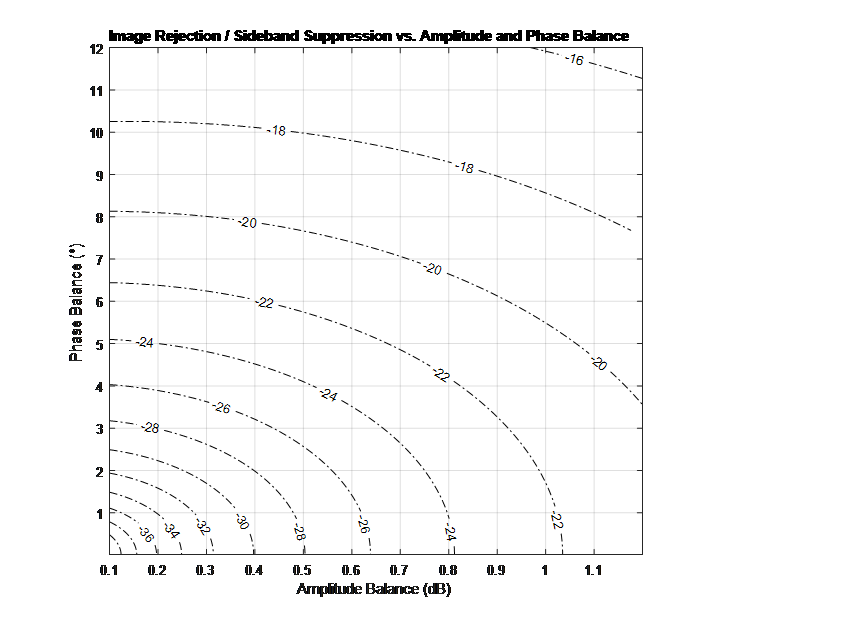
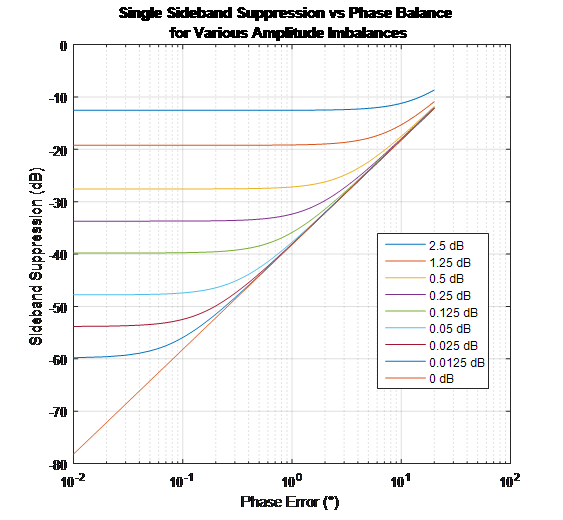
An interesting aspect of sideband suppression (or image rejection) is that it results from the net phase or amplitude balance. This means that if the phase balance on the LO quadrature signal generator is off by some error θ, it can be corrected by applying a phase differential of - θ between the I and Q ports of a single sideband mixer. This technique is used frequently in IQ communications systems, as errors in the IQ mixer can be corrected digitally.
In addition to the sideband suppression, the dynamic range of a system is limited by the isolation or spurious suppression as well. The 2IF x 1 LO spur and the LO feedthrough will both be separated from the desired tone by the IF frequency while the sideband is separated by twice the IF frequency, so both can limit the dynamic range even if the sideband is adequately suppressed. The bleedthrough of the LO signal is frequently higher in power than the suppressed sideband in a single sideband upconversion scheme, so filter requirements may not be reduced with a single sideband architecture without excellent LO-RF isolation.
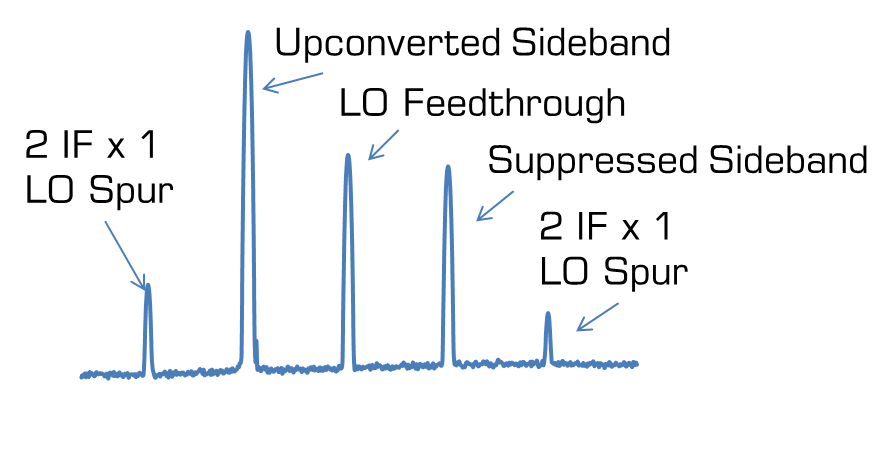
Realistic Single Sideband Upconversion Spectrum.
In the next section we will discuss how each subcomponent in the IQ/IR/SSB architecture can be implemented and affect the system dynamic range.
1) Hardware Limitations
The optimal implementation of an IQ/IR/SSB mixer depends intimately on the desired system goals, particularly with respect to size, performance in terms of bandwidth and dynamic range (usually inversely related to each other and cost/size), and what form factor or production method is available for realization (connectorized modules vs surface mount vs chip and wire assembly vs complete integration in an integrated circuit). It also depends on system economics, including required system cost and production volume. All functionality of an IQ/IR/SSB mixer can be realized for extremely low cost in a tiny package using either digital signal processing or analog CMOS circuits. This typically comes at a cost of lower operation frequency, narrower bandwidth, lower linearity, and higher development costs. For broadband, high dynamic range microwave frequency application the standard approach uses passive diode mixers. In the following discussion we will focus on the subcomponent tradeoffs for achieving broadband, high dynamic range IQ/IR/SSB mixers in a small, repeatable, planar package.
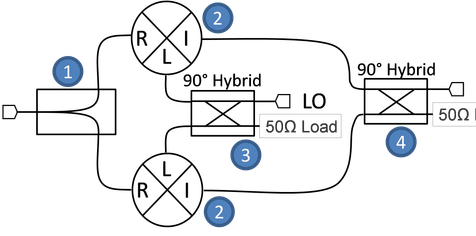
1) High Frequency RF In Phase Power Divider: The power divider is the most straightforward subcomponent to realize. IQ mixer operation requires excellent phase match and low loss across the RF operating band, and isolation is desirable to reduce spurious products. A resistive power divider is possible, but has high loss and no isolation. A reactive tee can be used as a splitter, but limits the bandwidth and provides no isolation in an upconversion (which can cause problems). The Wilkinson Power Divider provides the highest-performance solution with low loss, excellent phase matching, and good isolation, but requires more circuit area.
1) Matched Mixers: Options for mixers are abundant (single diode, balanced FET, Gilbert Cell, triple balanced, etc.), but for most microwave applications the best choice is the double balanced diode mixer. This mixer offers good isolations and spurious rejection, high P1dB, excellent repeatability in terms of phase delay and amplitude balance, and single ended operation on all three ports. It also has a DC IF capability that allows compensation of the LO-RF isolation. The more closely the mixers are matched, the better the sideband suppression and balance will be, so MMIC mixers with nearly identical diodes and passive structures are strongly preferred for this application. Furthermore, this mixer can be planarized to provide a compact form factor.
As mentioned above, the output of an IQ or single sideband mixer will be limited by the LO-RF isolation and the 2IF x 1 LO (and possibly 3IF x 1 LO) spurious products. The dynamic range (or bandwidth) of an image reject mixer can be limited by the 2LO x 2RF spur, which will be at twice the IF frequency. All of these performance limitations are inherited directly from the mixer core used in the IQ structure, so it is critically important to select the best possible mixer for this application. Additionally by selecting an appropriate diode level it is possible to tradeoff linearity and LO feedthrough. Therefore it is important to understand whether spurious products, LO feedthrough, or the signal sideband will be the limiting factor to dynamic range. For more on linear specifications, see Section 6: Linearity in IQ/IR/SSB Mixers.
2) LO Quadrature Signal Generation: There are several options for LO signal generation, and the preferred option depends on the application. Phase balance is the critical parameter for LO signal generation as it directly affects sideband suppression. Mixer performance metrics are only weakly affected by LO power, so the LO drive can be significantly unbalanced without a direct penalty to the sideband suppression. Uneven drive, however, will lead to duty cycle (i.e. phase) variations that will degrade sideband suppression.
For a single frequency LO, a power divider with a simple phase delay (either a length of transmission line or a phase shifter) can be used to create a nearly perfect 90˚ phase delay, as long as the frequency of operation is known. In this case the image rejection is limited by the amplitude and phase balance of the IF (which can be accounted for digitally). Other narrowband applications can use a simple branchline coupler.
In digital/CMOS implementations, a polyphase quadrature splitter can be made with very small size to reduce chip area, at the cost of very high loss for broadband designs as well as sensitivity to temperature and LO harmonic content. Alternatively, a digital divider can be used to create broadband quadrature LO signals, but with some noise addition from the digital logic, increased DC power consumption, low LO output power, and possibly additive phase noise.
For broadband analog designs in a quasi-planar form quadrature hybrid coupler is the best option. A quadrature hybrid coupler uses edge or broadside coupling to implement a backwards wave coupler with an equal power split. Marki has unparalleled expertise in the design and realization of planar quadrature hybrids in small form factors.
There are many electromagnetic effects that make broadband coupler design difficult, including dispersion, weak coupling, impedance control, etc. These effects must be carefully controlled for and simulated in broadband designs. Marki uses these advanced quadrature hybrid design techniques in our broadband MMIC IQ mixers and quadrature hybrids, which are suitable for applications from 2 to 110 GHz.
1) IF Quadrature Signal Divider/Combiner: The IF quadrature splitter/combiner is much more difficult than the LO quadrature splitter to realize in an integrated circuit because
a. the IF is at a lower frequency than the LO, which means that the quarter wavelength is significantly longer and
b. several of the techniques useful for LO quadrature signal splitting are not useful for splitting or combining broadband signals.
Fortunately there are two off-chip options available for performing the IF quadrature splitting/combining function. Analog splitting/combining can be accomplished with a large, low frequency surface mount quadrature hybrid. Fortunately there are many of these devices available at lower frequencies due to the popularity of high power balanced amplifiers, so they can be purchased from many different vendors. For high IF applications Marki offers MMIC quadrature hybrids from 2 to 18 GHz in bare die or surface mount form factors.
A more powerful but complicated method is to combine or divide the signal digitally. In this case two A/D converters (or D/A converters) are used to read (write) the signal to (from) the I and Q ports individually. This has the unique distinction of working from DC to the bandwidth of the ADC (or DAC). Additionally, impairments and imbalance in the IQ mixer itself can be digitally compensated. This is an incredibly powerful technique that is very popular as a result.
|
Structure |
Bandwidth |
Suitable for data or single frequency only? |
Size |
Benefits |
Limitations |
|
Digital Phase Shift |
DC-GHz |
Data |
Tiny |
Can be nearly perfectly implemented with software |
Limited by the DAC or ADC used to convert to the analog domain |
|
3 dB Quadrature Hybrid Coupler |
Up to 10:1 |
Data |
Large |
Multioctave Bandwidth, Phase Balance, Power Handling |
Design and fabrication challenging |
|
Digital Phase Splitter |
DC-10s of GHz |
Single Frequency |
Small |
Balance limited only by clock jitter |
Requires 2xLO frequency, low power handling |
|
Lange Coupler |
Up to 3:1 |
Data |
Medium |
Quasi-planar, suitable for MMICs |
Requires wire bonds or crossovers, limited power |
|
Polyphase Quadrature Splitter |
Suboctave |
Data |
Small |
Can be made in CMOS |
Loss, requires differential input, low isolation, sensitive to temperature and LO harmonics |
|
Schiffman Phase Shifter |
Multioctave |
Data |
Large |
Power handling |
Difficult to design, Esoteric |
|
Branchline Coupler |
30-40% |
Data |
Large |
Easy to implement |
Size and bandwidth |
|
Power Divider – Delay Line |
Single Frequency |
Single Frequency |
Large |
Easy to implement and tune |
Single Frequency |
1) Linearity in IQ, single sideband, and image reject mixers
Linearity is improved in IQ, single sideband, and image reject mixers over their standalone mixer counterparts in two ways:
1) Signal splitting reduces the signal power seen by each mixer (in some configurations). This can improve overall power compression (P1dB), two tone intermodulation (IP3), and higher order multitone intermodulation distortion (spurious). For more details, see table 2
|
Conversion |
Input IP3 and P1dB |
Output IP3 and P1dB |
|
IQ mixer upconversion |
No Effect |
Degrades by 3 dB plus excess insertion loss of the power divider |
|
IQ downconversion |
Improves by 3 dB plus excess insertion loss of the power divider |
No Effect |
|
Image Reject Downconversion |
Improves by 3 dB plus excess insertion loss of the power divider |
Improves by 3 dB minus the excess insertion loss of the IF hybrid |
|
Single Sideband Upconversion |
Improves by 3 dB plus excess insertion loss of the IF hybrid |
Improves by 3 dB minus the excess insertion loss of the power divider |
Table 2: Linearity Metrics: IQ/SSB/IR Mixer vs. Standalone Mixer
2) By dividing signals in quadrature and combining them in phase, some isolations and spurious signals either add in quadrature phase (3 dB improvement) or out of phase (~20 dB or more improvement). For example, the LO-RF isolation of an IQ mixer improves by at least 3 dB over the equivalent standalone mixer because the LO is split in quadrature and recombined in phase. For some higher order spurs the suppression improvement can be dramatic.
As with all claims about linearity in mixers, these theoretical improvements may or may not bear out in reality. Whether the linearity improves as expected depends on packaging, port impedances, harmonic content on the input signals, and other factors. Calculating the enhancement to spur suppression is complicated by the fact that the phase and amplitude error is multiplied for higher order terms. Each spur can be the vectorial sum of several products, leading to difficulty in calculating the expected spur suppression. For these reasons precise simulations are preferred to analytic solutions. The Marki PDK is an invaluable tool for predicting the spurious suppression of IQ, SSB, and IR mixers in realistic environments.
As an example of spur suppression in a single sideband mixer, Table 3 compares a simulation of the spurious suppression of the MM1-0312H as a standalone mixer and as a single sideband mixer. On the left is the standalone suppression, and on the right in parentheses is the suppression of the mixer when configured to suppress the lower sideband with ideal quad hybrids and an ideal power combiner.
In addition to the sideband suppression, the dynamic range of a system is limited by the isolation or spurious suppression as well. The 2IF x 1 LO spur and the LO feedthrough will both be separated from the desired tone by the IF frequency while the sideband is separated by twice the IF frequency, so both can limit the dynamic range even if the sideband is adequately suppressed. The bleedthrough of the LO signal is frequently higher in power than the suppressed sideband in a single sideband upconversion scheme, so filter requirements may not be reduced with a single sideband architecture without excellent LO-RF isolation.
|
LO Order |
|||||
|
IF Order |
1 |
2 |
3 |
4 |
|
|
-4 |
-78(-85) |
-57(-99) |
-71(-76) |
-59(-67) |
|
|
-3 |
-35(-40) |
-40(-50) |
-31(-81) |
-55(-70) |
|
|
-2 |
-58(-64) |
-43(-45) |
-57(-60) |
-49(-106) |
|
|
-1 |
0(-60) |
-13(-16) |
-6(-5) |
-34(-36) |
|
|
0 |
-35(-35) |
-22(-75) |
-51(-54) |
-36(-31) |
|
|
1 |
Reference |
-13(-16) |
-6(-62) |
-35(-38) |
|
|
2 |
-57(-63) |
-42(-45) |
-59(-63) |
-48(-96) |
|
|
3 |
-33(-81) |
-40(-50) |
-32(-40) |
-57(-79) |
|
|
4 |
-80(-80) |
-57(-98) |
-73(-83) |
-59(-66) |
|
Table 3: Simulated spur suppression of the MM1-0312H configured as a standalone mixer (configured as a single sideband upconverter with the upper sideband selected). LO = 15 (18) dBm @ 3 GHz, IF = 0 dBm @ 60 MHz
As you can see some tones show a minor improvement in suppression (such as the 1 LO x 2 IF) and some show dramatic improvement (such as the 1 LO x 3 IF) depending on whether the constituent spurs add in quadrature, in phase, or out of phase. All tones but one (the 3 LO x -1 IF) show improvement.
In comparison, Table 4 shows the experimentally measured spurious suppression of the MM1-1044H compared to the MMIQ-1037H with an external IF hybrid configured as a single sideband upconverter. The MM1-1044H is essentially a standalone version of the mixer inside the MMIQ-1037H, so one would expect a similar result to Table 3.
|
LO Order |
|||||
|
1 |
2 |
3 |
4 |
||
|
IF Order |
-4 |
-67(-90) |
-67(-80) |
-83(-94) |
-93(-101) |
|
-3 |
-23(-45) |
-45(-70) |
-27(-50) |
-47(-73) |
|
|
-2 |
-55(-66) |
-64(-57) |
-71(-65) |
-58(-74) |
|
|
-1 |
0(-13) |
-28(-43) |
-17(-33) |
-42(-53) |
|
|
0 |
-35(-37) |
-27(-21) |
-47(-27) |
-49(-40) |
|
|
1 |
Reference |
-29(-36) |
-17(-17) |
-41(-38) |
|
|
2 |
-57(-66) |
-60(-55) |
-73(-64) |
-58(-75) |
|
|
3 |
-23(-65) |
-46(-86) |
-28(-72) |
-48(-80) |
|
|
4 |
-68(-93) |
-70(-79) |
-80(-96) |
-91(-95) |
|
Table 4: Measured spur suppression of the MM1-1044H configured as a standalone mixer (MMIQ-1037H configured as a single sideband upconverter with the upper sideband selected). LO = 15 (18) dBm @ 10 GHz, IF = 0 dBm @ 60 MHz
Again the spurs almost uniformly improve, sometimes dramatically. The 1 LO x 2 IF is suppressed by an additional 9 dB, and the 1 LO x 3 IF is suppressed by an additional 42 dB. However, the harmonic LO isolations are all degraded, as well as the 3LO x ±2 IF and the 2LO x ±2 IF spurs. Further investigation showed that this was a result of package resonances in the IQ mixer packaging. The takeaways are that spurious suppression can be dramatically improved and that extremely precise modeling is required to determine what the exact impact will be.
7) Compensation of IQ/SSB/IR mixers
It is extremely common in practice to compensate for the intrinsic imbalance of an IQ mixer, especially in applications where a digital to analog converter or analog to digital converter is connected directly to the I and Q ports. It can be shown that the phase and amplitude imbalance of the IQ mixer can be perfectly compensated for by applying phase and amplitude offsets to the I and Q signals at the DAC or ADC, and the LO feedthrough can be reduced by applying DC voltage offsets to the I and Q ports. A typical procedure is as follows:
1) Apply the LO signal to the mixer. Add a positive or negative DC voltage to the I and Q ports of the mixer while measuring the LO to RF feedthrough to find the minimum value (do not exceed the datasheet specifications for IF current on the mixer).
2) Transmit a signal. Digitally adjust the phase balance and amplitude balance of the I and Q ports until maximum sideband suppression is achieved.
3) Repeat this process for all desired LO frequencies and across temperatures to ‘train’ the receiver/transmitter, and store the values determined.
In reality this method is limited by the resolution of the DAC or ADC and the timescale of the drift of the circuit, so it always results in a limited improvement over the intrinsic rejection ratio of the mixer. Therefore a high rejection mixer is desirable even when compensation techniques are used.
8) Conclusion
Integrating the complex functionality of IQ, image reject, and single sideband mixers into a small, planar package is extremely challenging. By combining precise fabrication with advanced mixer circuit design, Marki’s line of IQ mixers (the MMIQ series) and quadrature hybrids (the MQH series) offer superior performance. They can be used to create small form factor, high dynamic range transmitters and especially receivers that will enable significant architectural improvements for electronic warfare and test and measurement applications.
Related White Papers
Mixer Basics Primer
By Ferenc Marki & Christopher Marki, Ph.D.
|Published on: Thu May 14 2026 21:11:21 GMT+0000 (Coordinated Universal Time)
The Future of Filters Is Clear: Unlocking the Advantage of Glass Filter Technology
By Niki Mobtaker
|Published on: Fri May 01 2026 19:00:00 GMT+0000 (Coordinated Universal Time)
Benefits for Phased Array Systems Through Advancements in Surface Mount Components
By Doug Jorgesen
|Published on: Tue Apr 15 2025 19:00:00 GMT+0000 (Coordinated Universal Time)