Phase Noise Under Vibrations Calculator
Calculate a crystal oscillator phase noise induced by random vibrations, taking into account vibration damping mount (if available).

Tool Description
Background
Performance of various microwave components is impaired when exposed to environmental vibration. These might include resonators, cables, filters, and capacitors, of which the quartz crystal oscillators are the most prominent. Due to their electro-mechanical nature, crystal oscillators frequency is susceptible to acceleration. The relative frequency shift per unit of acceleration is called g-sensitivity and is measured in \(\frac{ppb}{g}\). The g-sensitivity is an intrinsic property of the oscillator which depends on its frequency, Q-factor, and crystal cut direction (SC or AT). When subject to random vibrations, the g-sensitivity relates the acceleration spectral density \(ASD(f)\) to the phase noise spectral density \(L(f)\), per the equation given below.
This application lets you easily carry out the acceleration spectrum to phase noise calculation, and also evaluate the performance when the oscillator is mounted on vibration isolators with given natural frequency and damping factor.
How to Use
To illustrate how to use this application we examine Vectron's \(10MHz\) TX-508 temperature compensated crystal oscillator (TCXO).
The TX-580 exhibits typical g-sensitivity equal to about \(0.4\frac{ppb}{g}\) and at-rest phase noise given in the table below. The TX-580 datasheet also includes a phase noise measurement under vibrations (also given below), where the oscillator is subjected to \(0.06\frac{g^2}{Hz}\) from \(20Hz\) to \(2KHz\).
| Offset (Hz) | Phase Noise at Rest (dBc/Hz) | Vibration Profile (g²/Hz) | Phase Noise Under Vibrations (from measurement) (dBc/Hz) |
|---|---|---|---|
| 10 | -95 | -95 | |
| 20 | 0.06 | -91 | |
| 100 | -123 | 0.06 | -105 |
| 1K | -143 | 0.06 | -127 |
| 2K | 0.06 | -133 | |
| 10K | -152 | -152 | |
| 100K | -155 | -155 |
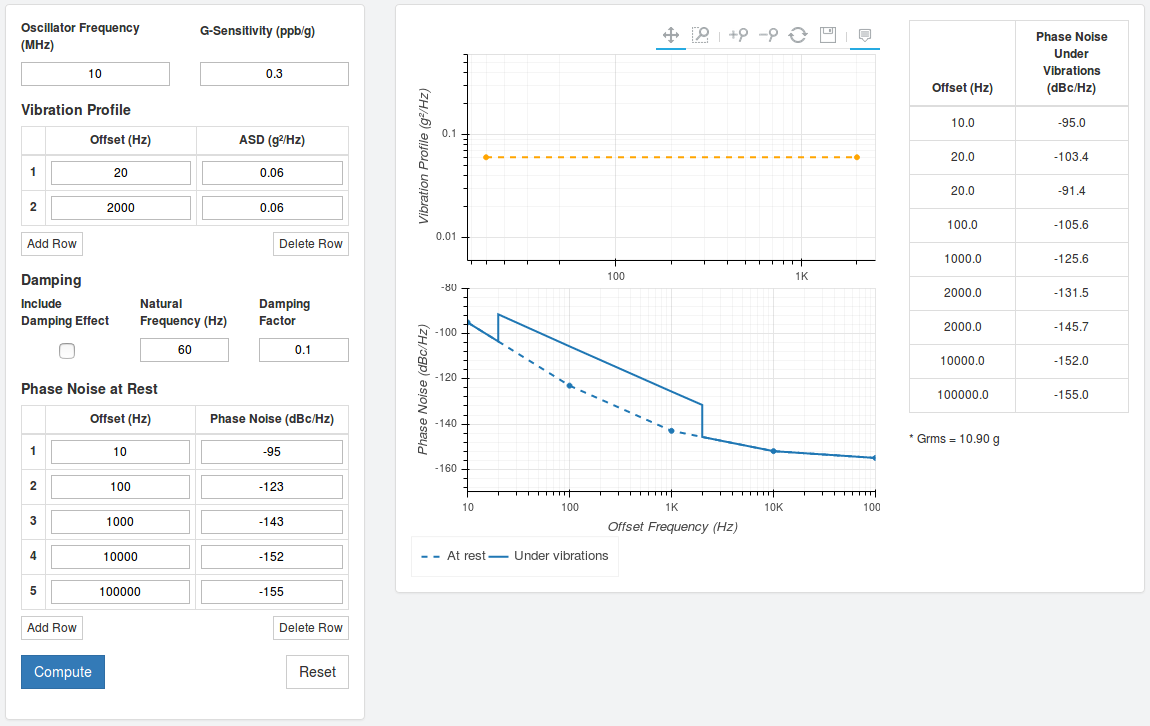
Let us first reproduce by calculation the measured phase noise under vibrations. Enter the oscillator frequency, g-sensitivity, vibration profile, and phase noise at rest. Once finished filling out all the fields, click Calculate to preform the calculation. The result is pretty close to the manufacturer measurement.
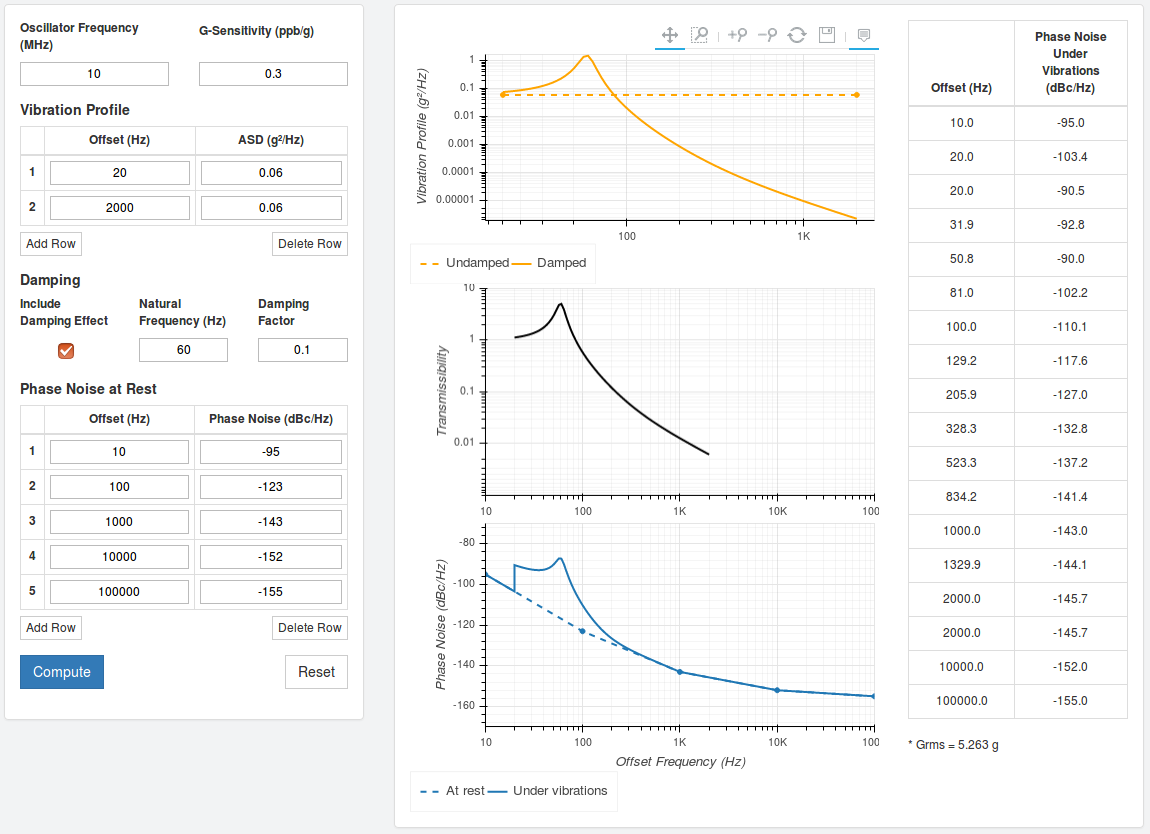
Now let's see what happens to the phase noise when the oscillator is mounted on vibration isolators with \(60Hz\) natural frequency and damping factor of \(0.1\). Checking the damping check box and entering these values gives the output below. Notice how, relative to the undamped case, the phase noise is amplified near the natural frequency and attenuated beyond it.
Equations
The application uses the following set of equations to carry the calculation.
The phase noise under vibrations \(L_{vib}(f)\) is given by $$L_{vib}(f) = L_{rest}(f) + \left(\frac{\Gamma T(f) \sqrt{2 ASD(f)} f_0}{2 f}\right)^2$$ where \(L_{rest}(f)\) is the phase noise at rest, \(\Gamma\) is the g-sensitivity, \(T(f)\) is the transmissibility, \(ASD(f)\) is the accelaration spectral density, \(f_0\) is the oscillator frequency, and \(f\) is the offset frequency.
The transmissibility with damping is $$T(f) = \sqrt{ \frac{1 + \left( 2 \zeta \frac{f}{f_{n}} \right)^2}{ \left( 1 - \left( \frac{f}{f_{n}} \right)^2 \right)^2 + \left(2 \zeta \frac{f}{f_{n}} \right)^2} }$$ where \(\zeta\) is the damping factor and \(f_{n}\) is the natural frequency.