Rev: D | Copyright © 2013 - 2014, 2019 - 2020 Marki Microwave LLC.

General Description

The BAL-0212 is a broadband balun, hand-tuned for optimal phase and amplitude balance over a 2.6 GHz to 12 GHz bandwidth. It serves as an excellent choice for analog to digital converters, balanced receivers, baseband digital modulations, and signal integrity enhancement.

Features

  • 2:2 Impedance Ratio
  • 2.6 to 12 GHz Balun (Balanced to Unbalanced Transformer)
  • Tuned for Optimal Phase/Amplitude Balance
  • Provides 50 Ω to 100 Ω Differential Transformation

Functional Block Diagram

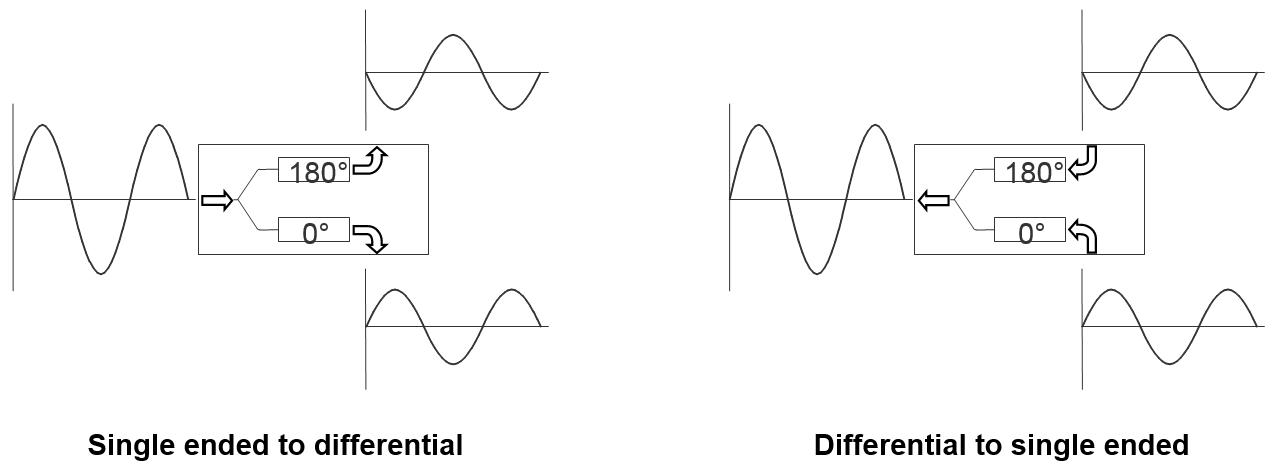
Block Diagram

Electrical Performance Summary

ParameterTypUnit
Frequency Range2.6 to 12GHz
Insertion Loss as a Mode Converter 1dB
Phase Balance 2°
Amplitude Balance 0.1dB
Impedance Ratio 2:1-
Common Mode Rejection 35dB

Summary only – refer to the Electrical Specifications, Absolute Maximum Ratings, and Recommended Operating Range tables for complete details.

Part Ordering Options

Part NumberDescriptionConnectorsGreen StatusProduct LifecycleExport Classification
BAL-0212BALUNStandard

REACH

RoHS

ReleasedEAR99

Table Of Contents

Typical Performance Scattering Parameters

Three port scattering parameters measured as three single-ended 50Ω ports showing relationship between any two ports. For example: S21 and S31, often referred to as insertion loss of a balun, is the output response on ports 2 and 3 with an input stimulus on port 1.

Common to output port insertion loss and output to output port Isolation graph for BAL-0212
Amplitude balance between output ports graph for BAL-0212
Return loss for common port and output ports graph for BAL-0212
Phase balance between output ports graph for BAL-0212
Common mode rejection graph for BAL-0212
Oscilloscope measurements with 10 GHz sine wave input. Excellent amplitude and phase balance are apparent. Note that the BAL-0212 is not suitable for baseband data, as any data input will be high pass filtered, particularly on the inverted side. graph for BAL-0212

Mixed Mode Scattering Parameters

Mixed mode scattering parameters are used to characterize differential circuits. For baluns, this means that the 0° and 180° ports become a single 100Ω differential port and the common port remains the same 50Ω common port. The two-port s-parameters of the balun are then characterized based on differential (d), common mode (c), or single-ended (s) signals. For example: S12ds is the differential output response given a single ended input.

S11dd graph for BAL-0212
S11dc graph for BAL-0212
S12ds graph for BAL-0212
S11cd graph for BAL-0212
S11cc graph for BAL-0212
S12cs graph for BAL-0212
S21sd graph for BAL-0212
S21sc graph for BAL-0212
s22ss graph for BAL-0212

Specifications

Electrical Specifications

Specifications guaranteed from -55 to +100°C, measured in a 50Ω system.

ParameterTest ConditionsMinimum
Frequency
(GHz)
Maximum
Frequency
(GHz)
MinTypMaxUnit
Frequency Range-2.6 12---GHz
Amplitude Balance -2.6 12-0.10.5dB
Common Mode Rejection -2.6 122535-dB
Insertion Loss as a Mode Converter -2.6 12-12.5dB
Isolation -2.6 12-6-dB
Nominal Phase Shift -2.6 12-180-°
Phase Balance -2.6 12-25°
VSWR (Input) -2.6 12-1.3--
VSWR (Output) -2.6 12-2.6--
Impedance Ratio -- --2:1--

Absolute Maximum Ratings

ParameterMaximum RatingUnit
RF Power Handling 5W

Package Information

ParameterDetailsRating
Weight-38g
Dimensions-36.32 x 36.32 mm

Port Configuration and Functions

Port Functions

PortFunctionConnector TypeDescriptionDC Equivalent
Circuit
Common Port / In (Unbalanced)RF Input SMAFThe common port is DC open.Equivalent circuit for the RF Input
Out 1 / 0° Port (Balanced)0° Port SMAFThe 0° port is DC shorted to the 180° port and DC open to ground.Equivalent circuit for the 0° Port
Out 2 / 180° Port (Balanced)180° Port SMAFThe 180° port is DC shorted to the 0° port and DC open to ground.Equivalent circuit for the 180° Port

Mechanical Data

Outline Drawing

Download : Outline 2D Drawing Outline 3D Drawing Outline 3D STP

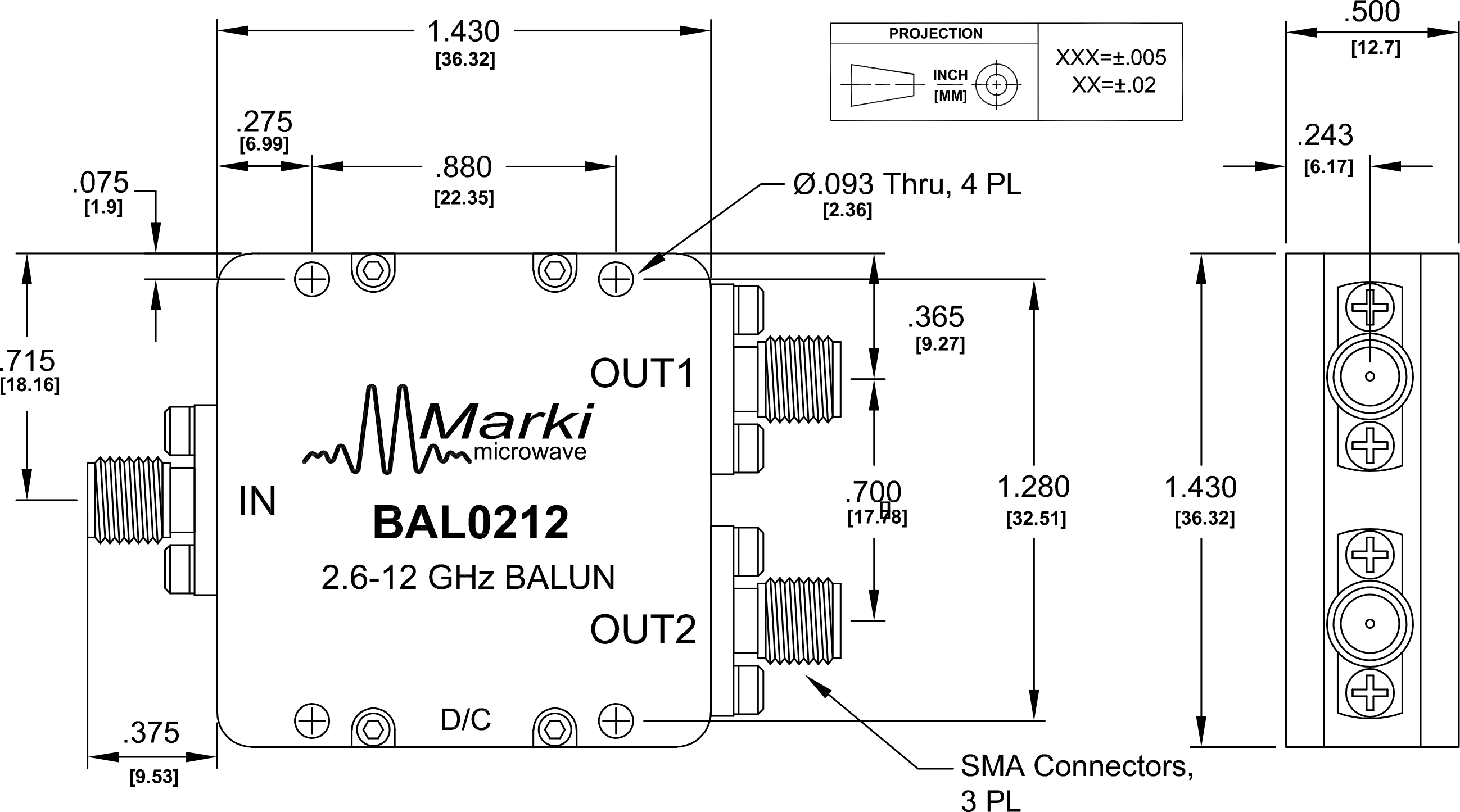
Outline Drawing

Revision History

Revision CodeRevision DateComment
-2013-01-01Datasheet initial Release
A2014-01-01DC Interface Added
B2019-10-01Mixed Mode Scattering Parameters added
C2020-07-01Specs table update
D2020-10-01Specs table update

DISCLAIMER

MARKI MICROWAVE, LLC., (“MARKI”) PROVIDES TECHNICAL SPECIFICATIONS AND DATA (INCLUDING DATASHEETS), APPLICATION OR OTHER DESIGN ADVICE, WEB TOOLS, AND OTHER INFORMATION AND RESOURCES “AS IS” AND WITH ALL FAULTS. MARKI DISCLAIMS ALL WARRANTIES, EXPRESS OR IMPLIED, INCLUDING, WITHOUT LIMITATION, ANY IMPLIED WARRANTIES OF MERCHANTABILITY, FITNESS FOR A PARTICULAR PURPOSE, OR NON-INFRINGEMENT.

These resources are intended for developers skilled in the art designing with Marki products. You are solely responsible for (1) selecting the appropriate products for your application, (2) designing, validating, and testing your application, and (3) ensuring your application meets applicable standards and other requirements. Marki makes no guarantee regarding the suitability of its products for any particular purpose, nor does Marki assume any liability whatsoever arising out of your use or application of any Marki product.

Marki grants you permission to use these resources only for development of an application that uses Marki products. Other reproduction or use of these resources is strictly prohibited. No license is granted to any other Marki intellectual property or to any third-party intellectual property. Marki reserves the right to make changes to the product(s) or information contained herein without notice.

MARKI MICROWAVE, M wave logo, FastSwitch, and T3 MIXER are trademarks or registered trademarks of Marki Microwave, LLC. All other trademarks used are the property of their respective owners.

© 2013 - 2014, 2019 - 2020, Marki Microwave, LLC