Absolute Maximum Ratings
| Parameter | Maximum Rating | Unit |
|---|---|---|
| RF Power Handling | 1 | W |

Sales: 408-778-9952 | General: 408-778-4200 | Fax: 408-778-4300
Sales & Customer Support: [email protected]
Tech Support: [email protected]
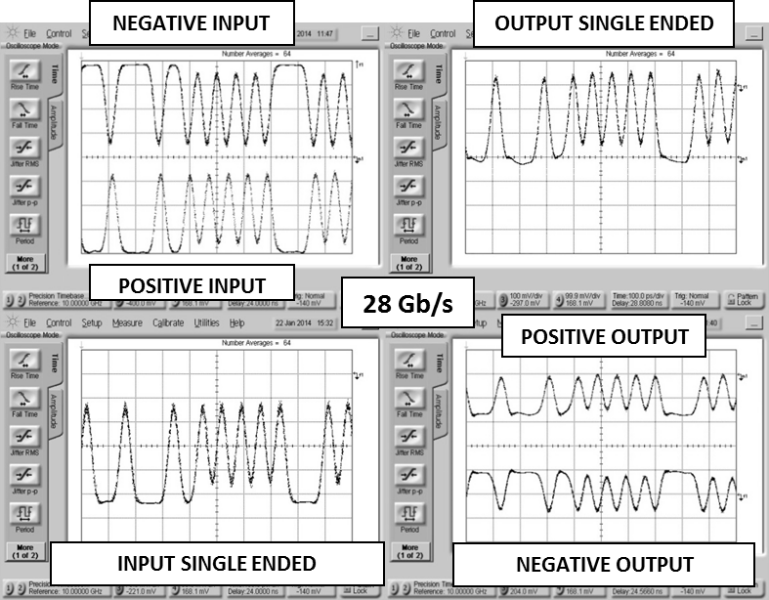
The BAL-0026 is a broadband balun, featuring high isolation and is hand-tuned for optimal phase and amplitude balance over a 300 kHz to 26.5 GHz bandwidth. It serves as an excellent choice for analog to digital converters, balanced receivers, baseband digital modulations, and signal integrity enhancement.


| Part Number | Description | Connectors | Green Status | Product Lifecycle | Export Classification |
|---|---|---|---|---|---|
| BAL-0026 | Broadband Isolation Balun (300KHz to 26.5GHz) | Standard | REACH RoHS | Released | EAR99 |
| Part Number | Description | Connectors | Green Status | Product Lifecycle | Export Classification |
|---|---|---|---|---|---|
| BAL-0026 | Broadband Isolation Balun (300KHz to 26.5GHz) | Standard | REACH RoHS | Released | EAR99 |
BAL-0026
Broadband Isolation Balun (300KHz to 26.5GHz)
| Revision Code | Revision Date | Comment |
|---|---|---|
| - | 2014-01-01 | Datasheet initial Release |
| A | 2016-01-01 | Typical Performance Plots Updated |
| B | 2019-10-01 | Mixed Mode Scattering Parameters added |
| C | 2019-11-01 | RoHS Compliant assembly |
| D | 2020-07-01 | Specs Table Update |
| E | 2020-10-01 | Specs Table Update |
BAL-0026
Broadband Isolation Balun (300KHz to 26.5GHz)
| Port | Function | Connector Type | Description | DC Equivalent Circuit |
|---|---|---|---|---|
| 0° Port (Balanced) | 0° Port | SMAF | The 0° port is DC connected to the common port through a resistor and to ground through a resistor. |  |
| 180° Port (Balanced) | 180° Port | SMAF | The 180° port is DC shorted to ground. | |
| Common Port (Unbalanced) | RF Input | SMAF | The common port is DC connected to the 0° port through a resistor and to ground through a resistor. | |
BAL-0026
Broadband Isolation Balun (300KHz to 26.5GHz)
| Parameter | Maximum Rating | Unit |
|---|---|---|
| RF Power Handling | 1 | W |
| Parameter | Details | Rating |
|---|---|---|
| Weight | - | 127g |
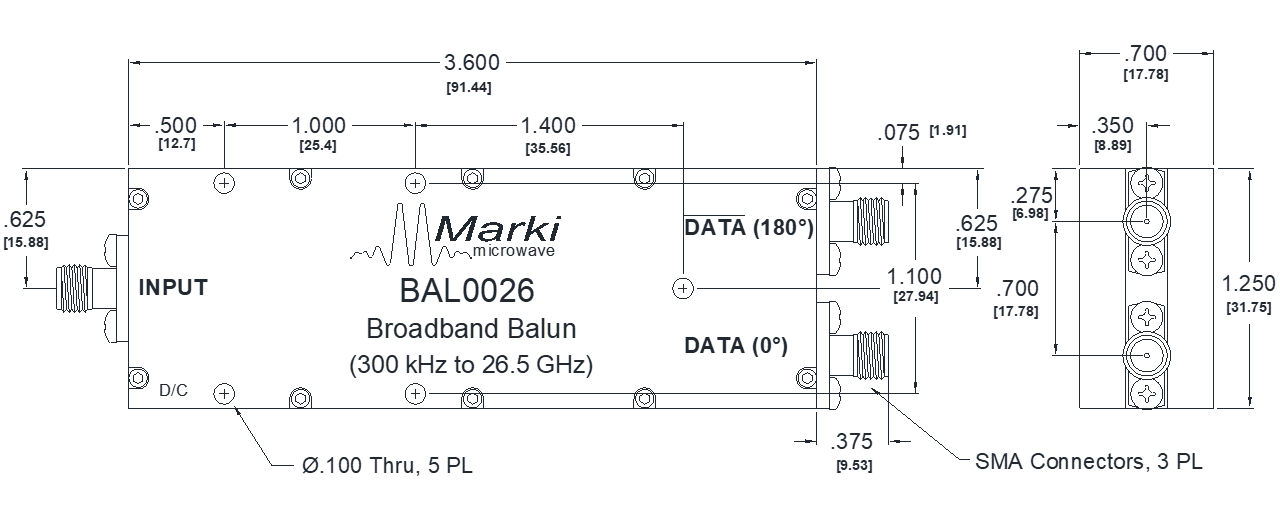
| Dimensions | - | 91.44 x 27.94 mm |
BAL-0026
Broadband Isolation Balun (300KHz to 26.5GHz)
Specifications guaranteed from -55 to +100°C, measured in a 50Ω system.
| Parameter | Test Conditions | Minimum Frequency (GHz) | Maximum Frequency (GHz) | Min | Typ | Max | Unit |
|---|---|---|---|---|---|---|---|
| Amplitude Balance | - | 0.0003 | 26.5 | - | 0.5 | 1.2 | dB |
| Common Mode Rejection | - | 0.0003 | 26.5 | 22 | 30 | - | dB |
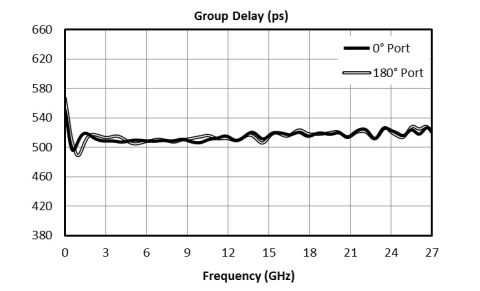
| Group Delay | - | 0.0003 | 26.5 | - | 520 | - | ps |
| Insertion Loss as a Mode Converter | - | 0.0003 | 26.5 | - | 2.5 | 4.5 | dB |
| Isolation | - | 1 | 26.5 | - | 24 | - | dB |
| Nominal Phase Shift | - | 0.0003 | 26.5 | - | 180 | - | ° |
| Phase Balance | - | 0.0003 | 26.5 | - | 3 | 10 | ° |
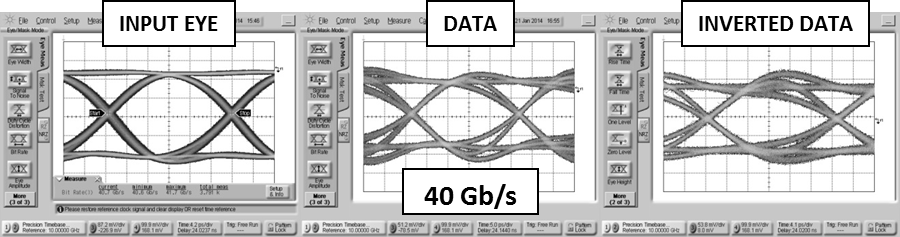
| Risetime/Falltime 1 | - | 0.0003 | 26.5 | - | 7.5 | - | ps |
| RMS Group Delay Ripple | - | 0.0003 | 26.5 | - | 8.2 | - | ps |
| VSWR (Input) | - | 0.0003 | 26.5 | - | 1.5 | - | - |
| VSWR (Output) | - | 0.0003 | 26.5 | - | 1.55 | - | - |
| Impedance Ratio | - | - | - | - | 2:1 | - | - |
| Parameter | Test Conditions | Minimum Frequency (GHz) | Maximum Frequency (GHz) | Min | Typ | Max | Unit |
|---|---|---|---|---|---|---|---|
| Amplitude Balance | - | 0.0003 | 26.5 | - | 0.5 | 1.2 | dB |
| Common Mode Rejection | - | 0.0003 | 26.5 | 22 | 30 | - | dB |
| Group Delay | - | 0.0003 | 26.5 | - | 520 | - | ps |
| Insertion Loss as a Mode Converter | - | 0.0003 | 26.5 | - | 2.5 | 4.5 | dB |
| Isolation | - | 1 | 26.5 | - | 24 | - | dB |
| Nominal Phase Shift | - | 0.0003 | 26.5 | - | 180 | - | ° |
| Phase Balance | - | 0.0003 | 26.5 | - | 3 | 10 | ° |
| Risetime/Falltime 1 | - | 0.0003 | 26.5 | - | 7.5 | - | ps |
| RMS Group Delay Ripple | - | 0.0003 | 26.5 | - | 8.2 | - | ps |
| VSWR (Input) | - | 0.0003 | 26.5 | - | 1.5 | - | - |
| VSWR (Output) | - | 0.0003 | 26.5 | - | 1.55 | - | - |
| Impedance Ratio | - | - | - | - | 2:1 | - | - |
[1] Specified as 90%/10%. Calculated from Tau_balun2 = (Tau_out2 – Tau_in2)
BAL-0026
Broadband Isolation Balun (300KHz to 26.5GHz)



BAL-0026
Broadband Isolation Balun (300KHz to 26.5GHz)

BAL-0026
Broadband Isolation Balun (300KHz to 26.5GHz)


BAL-0026
Broadband Isolation Balun (300KHz to 26.5GHz)
Mixed mode scattering parameters are used to characterize differential circuits. For baluns, this means that the 0° and 180° ports become a single 100Ω differential port and the common port remains the same 50Ω common port. The two-port s-parameters of the balun are then characterized based on differential (d), common mode (c), or single-ended (s) signals. For example: S12ds is the differential output response given a single ended input.


BAL-0026
Broadband Isolation Balun (300KHz to 26.5GHz)


BAL-0026
Broadband Isolation Balun (300KHz to 26.5GHz)